For the average recreational golfer, the commonly cited odds of making a hole-in-one are approximately 12,500 to 1. For an albatross, or double eagle — a 2 on a par 5 — it’s approximately 6 million to 1.
How about an ace . . .
. . . and two albatrosses . . .
. . . in the span of just four rounds?
Those odds are 1 in 14.5 quadrillion, according to one computation, which we’ll explain in a moment.
In other words, virtually impossible. And yet — you guessed it — it happened.
Enter Tyler Darling, a 45-year-old Vermonter with a 5.8 handicap index. Darling, who hails from Irasburg, just south of the Canadian border, plays in a men’s league at Orleans Country Club, where he has been a member for 25 years. As the owner of a log-home building company, Darling generally arranges his schedule to work half-days on Tuesdays so he can play a warm-up 18 before the evening men’s league match.
Darling’s first lighting-in-a-bottle moment came on Tuesday, Aug. 25, when he hit an 8-iron on the 157-yard par-3 3rd hole at Orleans CC. The ball landed just past the hole, and spun back to the edge. When Darling turned his back, the ball disappeared for an ace — only the second of Darling’s life. The first came during the Covid pandemic in 2020, when there was no one around to celebrate. This time, Darling had two witnesses and a clubhouse full of celebrants.
“It was right before men’s league, the course was busy,” Darling said. “They used to do a hole-in-one insurance, but they don’t anymore.”
Darling happily covered the $387 bar tab.
Darling played another round at Orleans a few days later, then teed it up again on Tuesday, Sept. 1, with his same playing partners from the previous week. On the 11th hole, a 485-yard par-5, Darling, a long bomber, hit his drive about 300 yards. With 187 left to the pin, he ripped a 7-iron and felt good about the ball’s direction. He never saw it finish, though, because of a rise in the fairway that obscured the landing area.
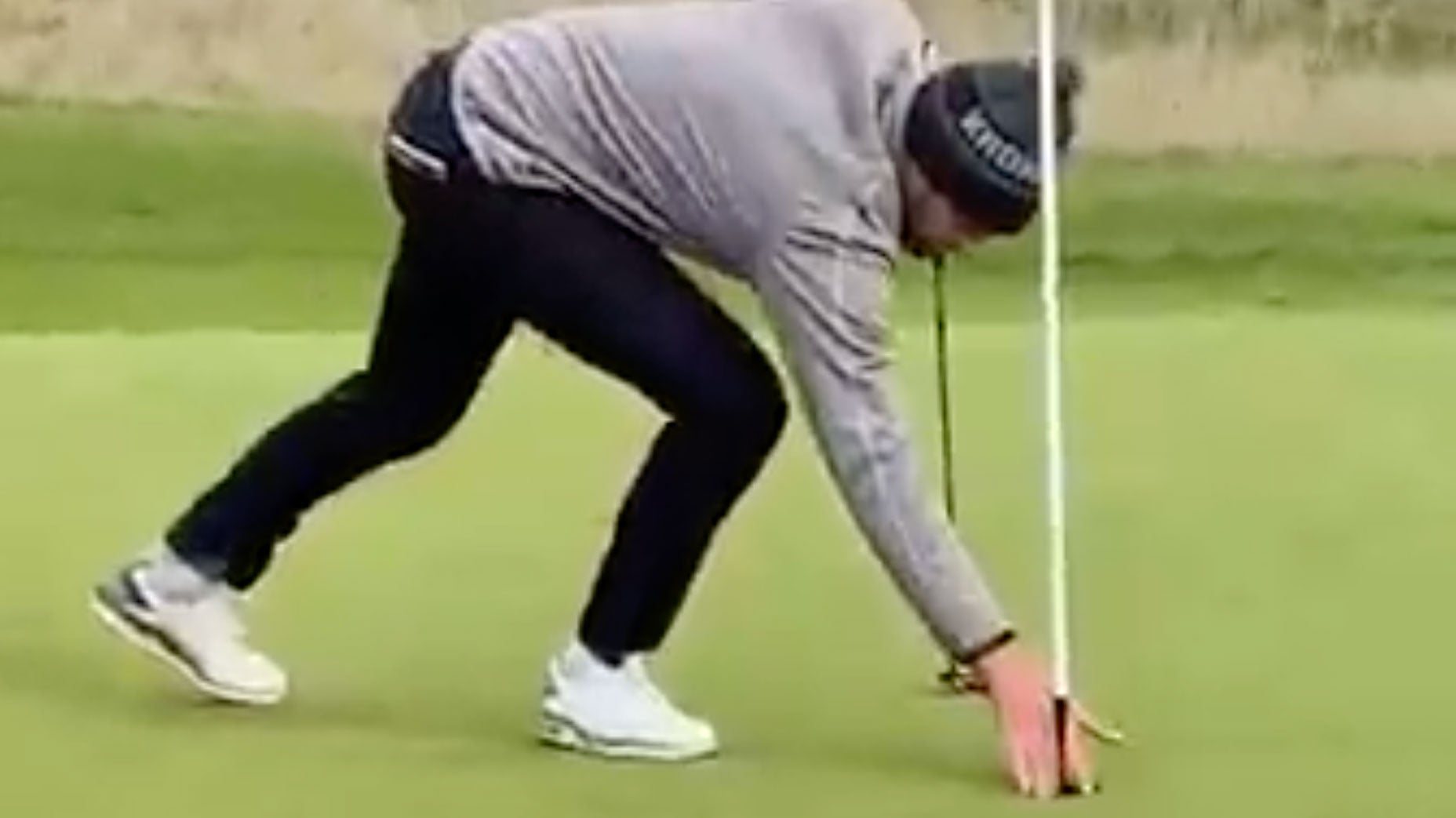
After a search for Darling’s ball around the green came up empty, the group checked one last place: the bottom of the hole. Bingo. A 2 on a par-5 — Darling’s first-ever albatross.
But it wouldn’t be the last.
On Tuesday, Sept. 8, two weeks after his ace and a week after his albatross, Darling returned to Orleans for a men’s-league match. On the 450-yard par-5 4th, he smoked a drive, leaving himself 120 yards to the pin.
With a gap wedge in hand — yep, more magic. His ball found the hole for yet another albatross. Once again Darling didn’t see the hole-out, because the green was elevated, but he did have a witness in his group.
Darling’s achievement was publicized on Orleans’ Facebook page where many commenters encouraged him to invest in lottery tickets.
“I don’t play that game,” Darling said with a laugh. “I’m pretty sure I used it all up.”

Darling’s four-round run of wizardry would make Jordan Spieth blush. A numbers-loving friend of Darling’s, Peter Laferriere, calculated the odds of Darling’s heroics, and shared the math with GOLF.com by email:
To find the probability of these three distinct milestones happening over a short timeline, sports probability models use a Binomial Probability Formula distributed over the specific opportunities (trials) available in a typical fortnight of play. Assuming a highly active schedule of 6 rounds of golf across those two weeks, a golfer faces exactly 24 par-3 opportunities and 24 par-5 opportunities.
The Binomial Formula: P(k; n, p) = n!/k!(n-k)! Å~ pk Å~ (1-p)n-k
Where n is the number of trials, k is the number of successes, and p is the single-shot probability.
1. Odds of 1+ Hole-In-One: Calculated at a baseline of 1 in 12,500 over 24 trials.
2. Odds of 2+ Albatrosses: Calculated at a baseline of 1 in 6,000,000 over 24 trials.
3. The Compounded Odds: Multiplying these probability frames together over the 14-day window fields a cumulative total of roughly 1 in 14.5 quadrillion (14,500,000,000,000,000 to 1).
To put that number into perspective, Darling’s streak is 42 million times rarer than winning the Mega Millions lottery jackpot. Even if Darling is an elite, low-handicap scratch player (which drops the individual albatross baseline to 1 in a million), the odds of this specific fortnight sit at a staggering 410 billion to 1.
GOLF.com did not independently corroborate Laferriere’s number-crunching but can confirm the odds are lonnnnng.
So, what’s left for Darling to tick off his list, other than perhaps a Vegas trip?
“I’ve never holed out on a par-4 on the second shot,” Darling said.
Give it a week or two.
The post This 5-handicap made a hole-in-one. Then came 2 more odds-defying swings appeared first on Golf.