Power in the golf swing comes via the arms and hands (your connection to the club) applying force to the club, and ground reaction forces (your connection to the ground) amplifying it. When they’re out of sync, power is elusive. But when they’re aligned, club speed increases and the ball goes farther — all with less effort.
What I’ve learned watching thousands of high-speed players — and measuring them with Swing Catalyst Force Plates — is what actually happens when they ramp up for speed. I’ve found that an easy way to teach the feel of what they are actually doing in the takeaway, transition and release is with a flywheel.
Below, you’ll find five “feels” and “reals” that, when optimized, will help you gain speed and yardage off the tee with ease.

The Feel: Hold the handles with your arms extended, making the flywheel line taut. Your feet should be firmly planted with maximum surface area in contact with the platform. Feel a subtle, rhythmic pressure shift from foot to foot as you prepare to initiate the swing.
The Real: Stand with your feet just wider than shoulder-width apart while your arms dangle naturally in front of you. With a wide stance, you will be able to increase the force shifting from side to side and generate more torque. The lead hip should be slightly bumped toward the target, allowing for an upward strike on the ball. Notice how the clubhead is hovering off the ground, displaying control of the club and body in a ready, engaged stance to begin the takeaway.

The Feel: Starting from the lead foot, shift your pressure toward the trail foot and let your trail hip go with it — just an inch or two, no more. Keeping the arms engaged, with the pressure moving over the trail side, the upper body is now in position to pull the flywheel line from the shoulder through the arms and hands.
The Real: This initial move off the ball is a load, not a sway. Feel the ground push back against your trail foot as your hip moves over it. Your head stays still, your lead shoulder begins to lower slightly and your trail knee flexes just enough to accept the pressure. This move is subtle, and often unnoticed by the untrained eye, but it is critical. Nailing the takeaway is crucial, as it begins the sequence that creates all the power in the swing.
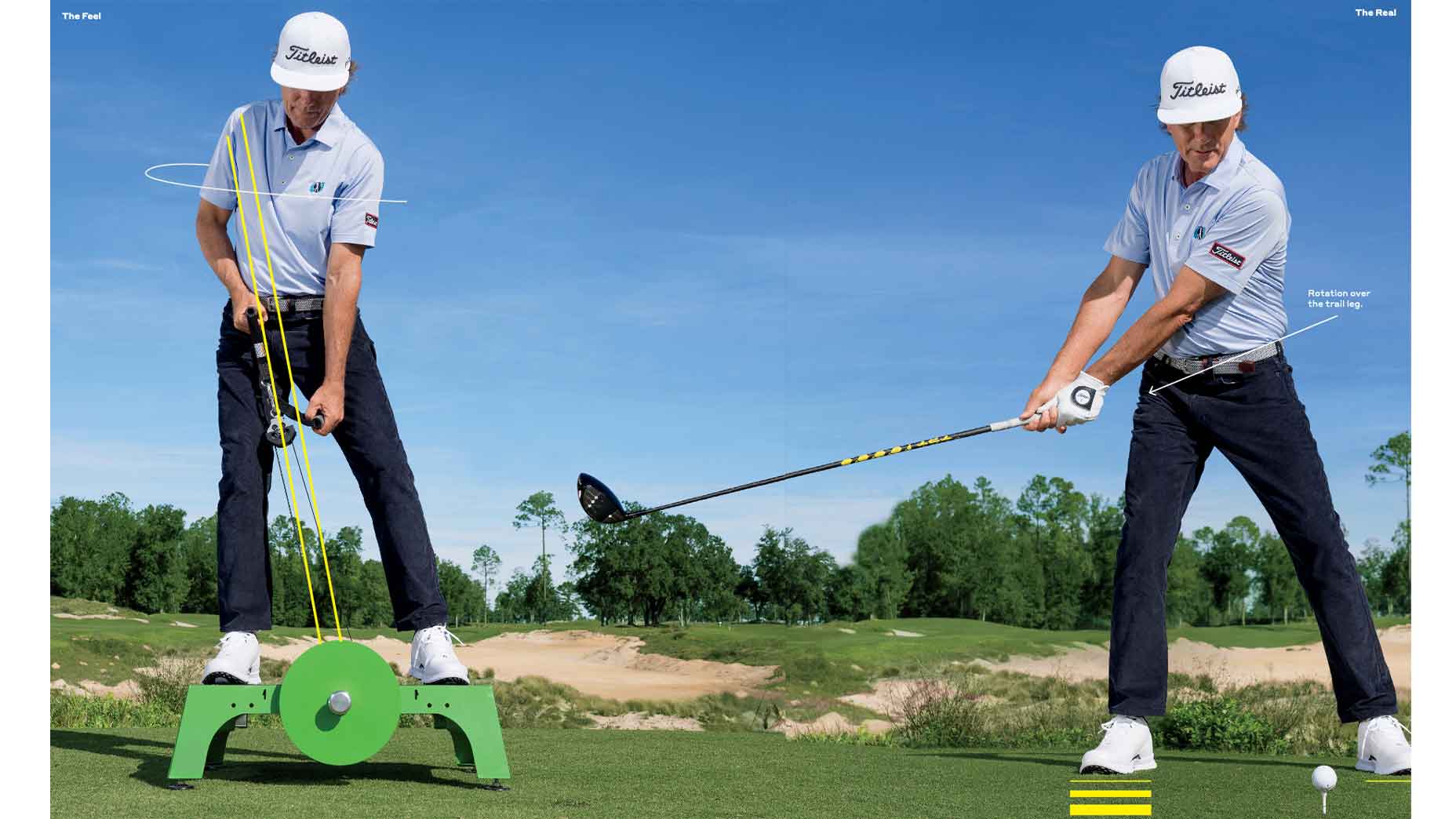
The Feel: With your trail foot loaded and your hips set, begin to rotate your upper body over your trail leg as your trail foot stays grounded. Feel the twist of your torso, creating torque between your hips and shoulders. The flywheel is now spinning up, coiling energy into the system. Your lead shoulder moves down and across the front of your body, as the back rotates more to face the target. This is the trail side beginning to extend and lengthen.
The Real: Before the clubhead gets above the hands in the backswing, you will feel heavier, creating the conditions to load and create power. Since the body and pressure initially shifted in Step 2, when the upper body rotates over the lower body, the trail hip will be inwardly rotated. Notice the crease at the top of the trail leg? That’s a result of the resistance between the upper and lower body, creating a coil-like effect that stores potential energy. Later in the swing that energy will be unleashed and send speed to the clubhead.

The Feel: At the top of the backswing, you should feel as if you are getting lighter due to the reaction force of the ground pushing back up, thanks to the loading you did in Step 3. Getting lighter at the top of the backswing increases forces in the downswing. Imagine diving off a springboard into a swimming pool. Making a small lift before crashing down on the board helps increase the load into the jump. This is a golfer’s power move to get more force out of the ground.
The Real: Your pressure lands on the lead foot first to start the downswing. Notice how the head stays in place over the trail side, and the lead side shifts to the target. At the same time, the hands and arms lower rapidly. Check out the Power Tip (below Step 5) for this important move.

The Feel: Extend your lead side and feel yourself pull up from the foot with your lead arm and shoulder. This provides an excellent feel for pulling back from the target and up from the ground. The lead side will drive this movement, allowing for full extension as you turn toward the target.
The Real: Your lead side extends and allows the lead hip to rise and clear. As this happens, your entire body braces and lets the clubhead fly past your hands to the finish. The club isn’t swung so much as it is carried to the finish by the wave of energy you loaded, transferred and released. This is the moment when all of the energy you generated from the start of the swing is unleashed into the ball, creating your most powerful golf swing.

If you want your clubhead to go fast, you actually need to decelerate your hands before impact — seriously! Most golfers struggle with this feel, which is why I developed a training aid called the Speed Brake. This aid helps coordinate the hands and lead side as they decelerate (shown in Step 4), which triggers the speeding up of the clubhead. When the hands decelerate rapidly before impact, it sends all the energy out to the clubhead, much like what happens when you snap a towel. If you pull the handle through impact, rather than slow it down, you’ll have much less power and worse contact. So, remember, if you want to go fast, you need to slow down.
The post Gain speed — and yards! — with these 5 steps appeared first on Golf.