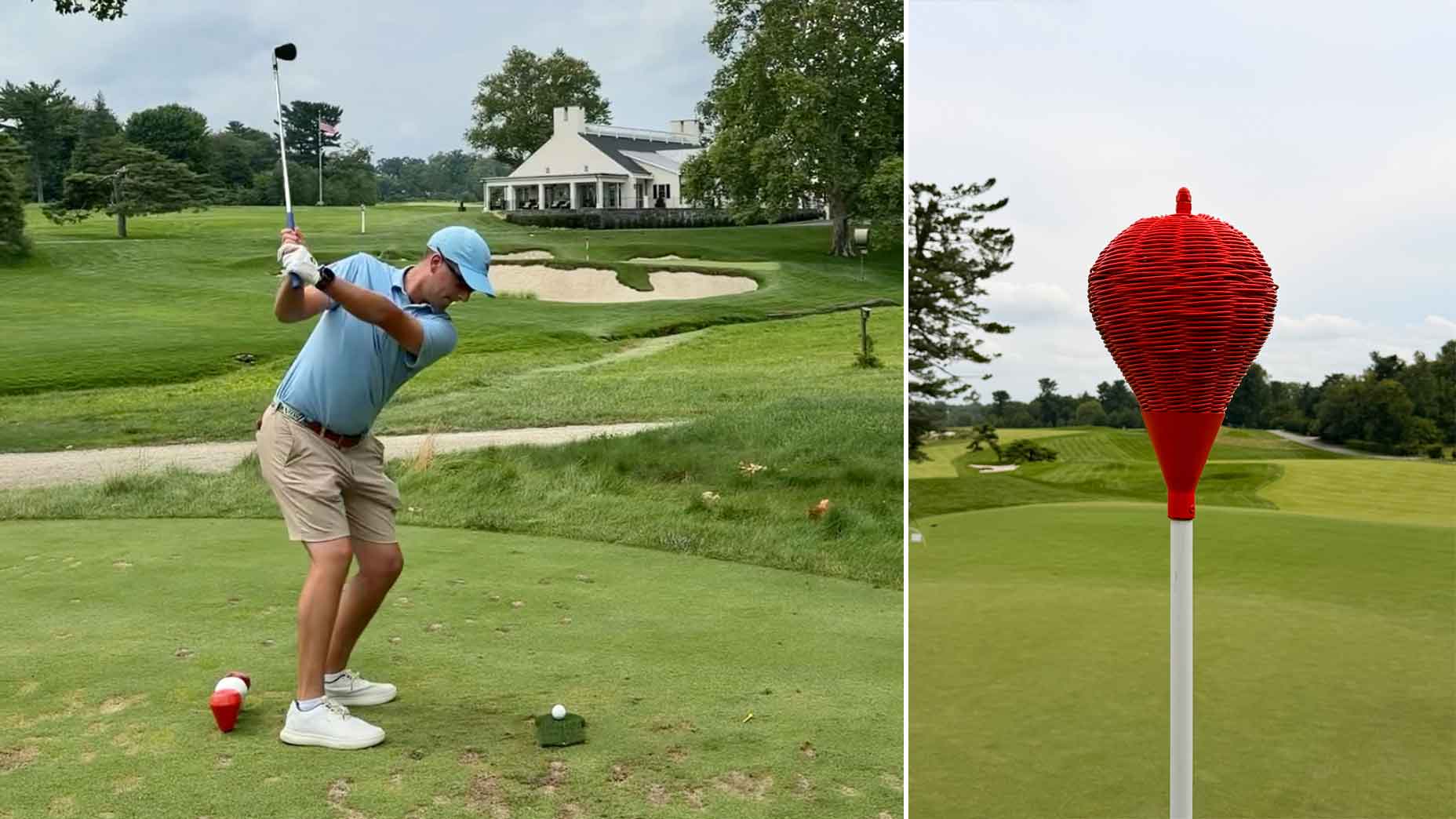
ARDMORE, Pa. — Walking into a U.S. Amateur with four players gives you a unique perspective on preparation. They’re playing the same golf course, facing the same conditions and competing for the same championship, but that doesn’t mean they should prepare — or play the golf course — the same way. That has been one of my biggest focuses this week at Merion and Philadelphia Country Club.
My four players have very different games. One has tremendous power. Another wins with patience, positioning and putting. One relies heavily on precision and his scoring clubs, while another is a complete player who simply loves to compete. My job isn’t to give all four of them the same game plan. It’s to help each player understand where his strengths can give him an advantage, where his weaknesses can’t get exposed and how his particular game fits Merion.
At a championship like the U.S. Amateur, we aren’t trying to rebuild golf swings during practice rounds. We’re trying to create a unique game plan that each of them can execute under pressure.
A lot of our work at Merion had very little to do with the golf swing. We talked constantly about course management: Where can we be aggressive? Where do we need to be patient? Where is par a great score? And, maybe most importantly, where can we absolutely not miss?
On approach shots, we weren’t simply getting numbers to flags. We wanted to know how far the ball needed to fly onto each green, where it needed to land, what the contours would do to it after it landed and where the proper miss was.
The fifth hole is a great example. Players are hitting longer clubs into the green, which already makes controlling the approach more difficult. The green also has significant slope from right to left. If you miss on the right side, getting the ball up and down can become almost impossible because you’re recovering from the wrong side of the slope.
So instead of simply asking, “What’s the number to the flag?” we want our players asking better questions: How far does the ball need to fly onto the green? Where should it land? How will the slope move it once it gets there? And if I don’t hit this shot perfectly, where can I leave it and still have a reasonable next shot?
That is what a practice round should accomplish. By the time a player faces that shot during the championship, I don’t want him discovering the answer. I want him to already know it.
One of my players has close to 130 mph of clubhead speed. There are things he can do on a golf course that most players simply can’t. But one of our biggest conversations was about patience. When you have that much speed, it can be tempting to stand on every tee and immediately search for the most aggressive option. At Merion, that isn’t always necessary. In fact, his power sometimes allows us to be more conservative.
The 11th hole is a perfect example. The priority for him is hitting the fairway. He can hit a 5-iron from the tee and still leave himself a wedge into the green. Why introduce additional risk when his length has already created the advantage? If he misses the fairway, the hole becomes significantly more complicated.
The 12th presents a similar decision. It’s a slight dogleg to the right, and missing the fairway to the right can make getting the ball onto the green extremely difficult. Again, the question isn’t, “How far can we hit this tee shot?” It’s, “Where does this tee shot need to finish?”
His advantage isn’t simply how far he can hit the driver. It’s what his speed allows him to hit next. He can choose a more conservative club from the tee and still have a scoring club in his hands for the approach. We talked about being willing to make a lot of pars and not getting greedy.
There will certainly be moments when his power creates an opportunity other players don’t have, and when those opportunities come, we want him to take advantage of them. But he doesn’t need to overpower Merion on every hole. Sometimes the smartest way to use power is knowing when you don’t need it.
The conversation with my second player is different. For him, we talked constantly about staying in position. Being in the fairway is extremely important, even if that means leaving the driver in the bag. There is very little value in gaining another 20 or 30 yards if those yards leave him playing his next shot from the wrong place. I want him thinking one shot ahead: Where does this tee shot need to finish to give me the best opportunity with my approach?
That thinking continues around the greens. We talked a lot about avoiding the short side. At Merion, missing a green isn’t always the mistake. Missing it in the wrong place can be.
There will be hole locations where the flag simply isn’t the target. The correct play may be the middle of the green or an area that leaves the easiest possible next shot if the approach isn’t perfect. That style fits his personality and his game. He’s comfortable being patient, understands that par is a good score and is a very good putter. He doesn’t need to manufacture birdies.
If he continually keeps himself in position, he can allow his putting to become an advantage and let opportunities come to him.
With my third player, the message may be the simplest of all: We can’t afford big numbers. His strengths are accuracy, his scoring clubs from 50 to 150 yards and his short game. Our strategy needs to give those strengths as many opportunities as possible. That may mean choosing more conservative clubs from certain tees, but the bigger conversation is about what happens when something goes wrong.
Merion can punish the instinct to immediately try to recover everything. If we get out of position, sometimes the best decision is simply to put the ball back in play. Accept the situation. Give yourself an opportunity to save par — or even make bogey — and move on.
That’s where emotional control becomes part of course management. One poor swing doesn’t have to become a poor hole, and one poor hole certainly doesn’t have to affect the next one. For him, eliminating big numbers isn’t only about execution. It’s about eliminating the decisions that turn a small mistake into a much bigger one.
My fourth player is different because he does just about everything well. He has plenty of speed, he’s a very good ball striker, he keeps the game fairly simple and, most importantly, he loves to compete. With him, I don’t want to overcomplicate things. Our conversations have been about staying present and accepting that shots don’t have to be perfect.
A U.S. Amateur at Merion is going to create uncomfortable situations. There will be difficult lies, awkward shots and moments when a good swing doesn’t produce the result you expected. The challenge is not allowing those moments to create frustration. Accept where the ball finished, understand the situation in front of you, make the next decision and compete.
Part of that is having an honest understanding of both your strengths and weaknesses. Great course management isn’t just knowing the golf course. It’s knowing yourself well enough to make decisions that fit your game. For him, I want to keep the message simple: Stay present. Accept imperfect shots. Compete from wherever the ball finishes.
The greens at Merion created another important conversation that applied to all four players. I was constantly reminding them to play enough break, particularly on putts outside 20 feet. With greens this fast, an under-read can become expensive very quickly.
Once a putt misses on the low side, the slope can take over and the ball begins running away from the hole. Suddenly, a 25- or 30-foot birdie putt has turned into a five- or six-foot putt coming back. That’s why playing enough break is also part of speed control.
From longer distances, we’re not simply thinking about making the putt. We’re thinking about controlling where the ball finishes when it doesn’t go in. Playing enough break allows the player to use the slope and match the read with the proper speed instead of fighting the slope by hitting the putt harder. Great lag putting isn’t simply about how hard you hit the ball. Your read determines the speed you need to use.
Over 36 holes of stroke play, eliminating those unnecessary five- and six-foot comeback putts can be just as valuable as making a few extra birdies.
The post The hidden art of preparing for a U.S. Amateur at Merion appeared first on Golf.