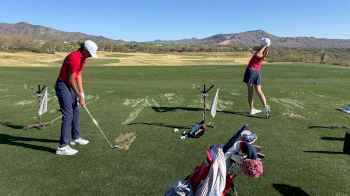
I have the opportunity to watch golfers of all skill levels on the practice range. As an instructor, my teaching eye naturally scans the swings as players try to launch that little ball into the air and keep it straight.
It’s always fun to watch someone celebrate a great shot. What’s a little harder to watch is seeing the same mistake repeated over and over without any adjustment, often relying on hand-eye coordination or luck rather than sound technique.
Here are my suggestions for getting the most out of your practice time without the guidance of an instructor.
The driver might be the most exciting club in the bag, and it certainly has the potential to hit the ball the farthest. However, it’s not the best club to begin with.
If I were choosing a starting club, I’d recommend either a sand wedge or a gap wedge. These clubs are shorter, making them easier to control. They also have a rounded sole that helps the club glide along the ground when it makes contact with the turf.
For new golfers, this encourages the important habit of allowing the club to reach the ground through impact rather than trying to lift the ball into the air. Once you’re consistently making solid contact with a shorter club, gradually work your way up to the longer clubs and eventually the driver.
There is an incredible amount of golf instruction available online. Spending just five minutes watching a quality video on grip and posture can make a huge difference before you start hitting balls.
Believe me — the stranger standing next to you on the range is probably not your best source for swing advice.
Anything that helps produce solid contact and good results is valuable when you’re learning, especially if you’re practicing without guidance.
Teeing the ball up makes it much easier to get the ball airborne. If you’re struggling to get the ball in the air, don’t hesitate to raise the tee until you start seeing consistent flight.
Don’t view a higher tee as a crutch. Think of it as a learning tool that helps you experience successful shots, build confidence and enjoy the game more.
Since the ball is sitting on a tee, your goal should be to strike the tee after you hit the ball. Understanding that the club must travel down to the ball, and into the ground slightly afterward, is essential for solid contact.
It can even be helpful to practice swinging and clipping the tee without a ball. This helps eliminate the natural instinct to lift the ball into the air, which is one of the most common mistakes beginners make.
Learning to strike the tee consistently trains the proper motion of the club and leads to cleaner contact, better ball flight and more enjoyable practice sessions.
If an in-person lesson isn’t practical, or if you’re leaving the range frustrated and unsure what to work on, online lessons are an excellent option.
Many instructors offer video analysis, allowing you to film your swing, send it in and receive personalized feedback that you can apply during your next practice session.
The important thing is to get quality feedback. A few small adjustments can save you countless range balls and help you improve much faster.
The post 5 suggestions for optimal practice without getting lessons appeared first on Golf.