NEWTOWN SQUARE, Pa. — The beauty of it all, at the end of the day and at the end of this 108th PGA Championship, is that AI cannot touch it. Along those same lines, you can spend all the money you want on marketing, you can do whatever you may care to do on Instagram and X, and you can YouTube yourself until your face turns blue.
But by Sunday night at a major, as this global cross-country proves again and again, the shots are the shots, the scores are the scores, the lies are the lies, the weather is the weather — and none of it is for sale. Live golf is a place where prediction markets can go to die. How great is that?
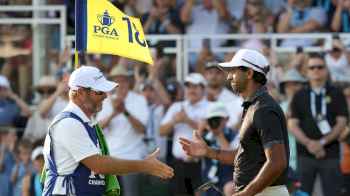
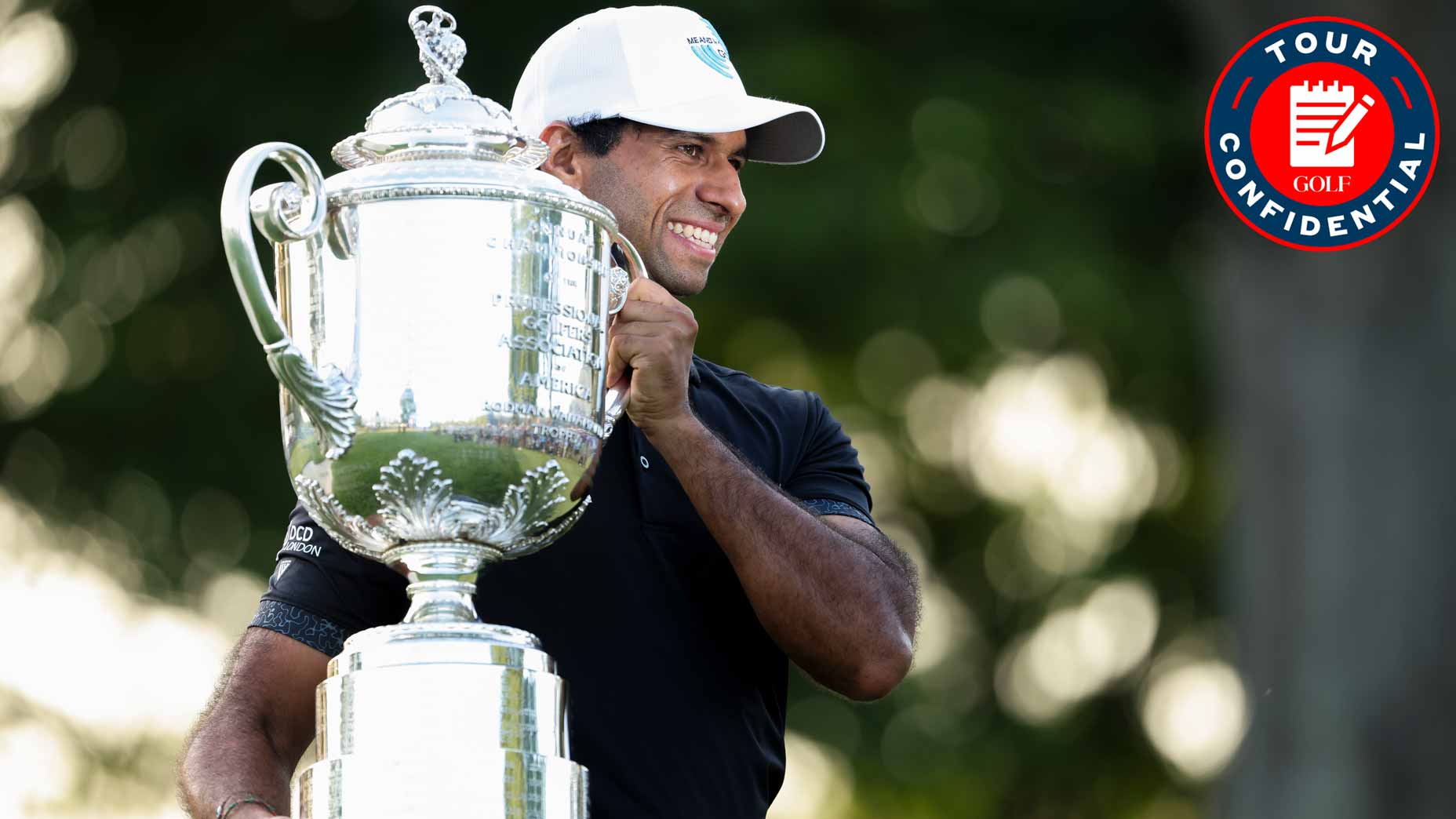
This PGA Championship was not won by Jon Rahm, Cameron Smith, Rory McIlroy, Xander Schauffele, Justin Rose, Patrick Reed, Matt Fitzpatrick, Scott Scheffler, Jordan Spieth or 54-year-old Padraig Harrington, to offer you the full list of former major winners who finished under par here. It was won by Aaron Rai, hardworking 31-year-old Englishman of Indian descent who plays on the PGA Tour and lives in Jacksonville, Fla. He earned the right to hoist the Wanamaker Trophy the old-fashioned way. He nine under parred it.
Rai won by three over Rahm, who is also 31. In the alphabetical listings for next year’s European Ryder Cup team, nobody is getting between these two guys. Appearance and manner is another thing. Rahm’s beard alone has to be worth a half-shot on any given Sunday, just as Rory McIlroy’s down-the-fairway strut is worth something. Rai, with his slender physique and modest manner, with a golf glove on his left hand and on his right, is not going to make other pros quiver on their way from the first tee to the first green. But Rai’s rounds at Aronimink were 70, 69, 67 and 65. This Donald Ross course played hard, for four straight day. He played some studly golf.
“It definitely feels like a journey,” Rai said in victory, in a British accent that hints at his own long path from a working-class town on the outskirts of Birmingham, England, to this leafy Philadelphia suburb. “Everybody in this field has a journey to share, and I’m not an exception to that.” What a selfless and modest thing to say. One thing this man is not, for sure, is a country-club brat.
This win did not come out of nowhere. (Except maybe in this sense: Rai played in the third-to-last group of the day, not a likely twosome to produce the winner. Then again, when the leaders are stacked like sardines in a can through three rounds, as they were here, winners can come from most any starting time.) Rai turned pro at 17 and has spent 14 years playing the world and getting better through the years and on the shoulders of these many miles.
Gary Player, the great South African golfer who won the 1962 PGA Championship here, turned pro at 17, too. Player is 90 now and was at the awards ceremony on Sunday night, wearing a blood-red blazer and a grandfatherly smile. Player is forever celebrating the global game and unlikely paths to excellence. He welcomed Aaron Rai to golf’s center stage with sting-your-hands applause.
Maybe you didn’t have Rai in your office pool. Maybe you weren’t talking about him around the barbeque on Saturday night. That’s not his fault. The opposite. That’s the thing we’re celebrating here. The Masters was won by a son of working-class Belfast. McIlroy has a well-known journey in this game, but every golfer, pro or am, has a journey story to share. You can always ask other golfers about their starts. It will always yield an interesting answer. Aaron Rai started at a par-3 course near his family’s home. His parents would take him there.
Tour Confidential: Aaron Rai’s PGA win and a bizarre week at Aronimink
For the better part of 100 years, the winners of men’s majors were exclusively white. Then came Vijay Singh, Tiger Woods, Michael Campbell, J.J. Spaun, now Aaron Rai. Someday and not too long from now this won’t be a thing at all. Until that time, it’s worth noting, because this game is better when people from every possible background, and from all corners of the globe, have a path to it. You can’t win a major if you don’t have a place to start playing in the first place. Aaron Rai started playing at the 3 Hammers Golf Complex. He won at Aronimink.
He was at the awards ceremony with his wife, Gaurika Bishnoi, a professional golfer herself. If her Indian name does not trip off your tongue, you can always practice it. That’s up to you. Saturday night, with dusk approaching, Rai was practicing alone in the short-game area here. No caddie, no bag, no entourage. Just one lone golfer wearing two gloves playing one pitch shot after another with one club.
Maybe Rai will win more majors, maybe he won’t. We can promise you this: He is not a fluke winner. He is not a flash in the pan. He just was not the guy you were expecting to win.
His manner is lovely. In victory, he spoke of his wife, movingly. He spoke of his parents and his siblings and their sacrifices for his golf. He spoke of his sponsor — not a company but an actual person, a man named Shabir Randereenot, a sort of second father to Rai. He spoke of this game and his path through it. If you’re looking for a new golfing hero, one with no sense of entitlement, we point you to this newest name on the Wanamaker Trophy.
“There’s so much hard work and discipline that goes into acquiring the skills to become better,” the winner of this 108th PGA Championship said Sunday night. “Nothing is ever given in this game.”
He spoke of the focus golf requires, the attention it demands, the lessons in humility it offers. Humility, Aaron Rai said, was one of golf’s core values, and at the foundation of his life, too.
Michael Bamberger welcomes your comments at Michael.Bamberger@Golf.com
The post Aaron Rai isn’t the PGA Championship winner you expected. And that’s OK! appeared first on Golf.