On any given day, Trevor Immelman will narrate the seminal moment of someone’s life. With the stage clear and the stakes high, he will speak in concise paragraphs that communicate the breadth of the human experience to millions of attentive viewers. His voice will not waver and his enthusiasm will not wane. He will do all of this without much second thought, delivering this marvel of human communication with trademark earnestness and wit.
And then, if he’s unlucky, he’ll venture out into the world and see something truly scary: A surprise.
“Oh gosh,” Immelman said on a bright morning this spring, his eyes temporarily breaking their relentless gaze as they retreated into the corner of the room in front of him.
Immelman sat there for a moment, his mind searching for an answer to a question that made little sense and arrived with even less warning. For the first time all morning, and maybe all year, he was on his heels.
Up until that very moment, Immelman’s day had transpired precisely on-script. He’d carefully selected our meeting spot days in advance — a trendy coffee shop in his native Winter Park, Fla. recommended by his good friend, the coffee-obsessed Aussie Adam Scott. He’d vetted the menu to ensure there would be a suitable breakfast option to protect against any caffeine-induced jitters (a gluten-free breakfast burrito). And he’d arrived his customary ten minutes early, wearing his usual trim polo and matching Nikes.
At no point in his vision for the day did Immelman see himself fumbling around to identify his greatest skill … and in no world did he picture himself settling on an answer that included the words Big Green Egg.
“I guess I would say … grilling?” Immelman said, apologizing for the words almost as soon as they tumbled out of his mouth. “That’s such an unserious answer.”
Immelman’s distaste was palpable, but it was already too late. Soon he was talking about the South African tradition of braai, a tremendous wood-fired cookout that defines social life in his home country. Immelman has not lived in South Africa since he was a teenager, but he still cooks by the fire almost every day — a connection to his home a few continents away.
“We call it a long lunch — it starts at lunch and ends at midnight,” Immelman says, grinning. “The vast part of our culture is spent bringing people together, and now I think I’ve got five different rigs I could be using. It could be the smoker, it could be fire, could be gas when I’ve got the time.”
If it sounds strange to attach greater meaning to a man’s affinity for cooked meats, you’ve clearly never spent much time listening to Trevor Immelman. In golf as in television as in his culinary pursuits, Immelman does not believe in having an ace up his sleeve — he believes in having five of them. His secret to success belongs not to skill or luck but to the primordial powers of preparation.
“I gained confidence from arriving at a tournament knowing that nobody had outworked me,” he says now. “That was kind of my thing.”
On television, Immelman’s obsessive work ethic has multiplied his gifts. A successful career as a pro golfer has bloomed into a growing presence as one of the sport’s most influential voices. In addition to his duties as a broadcaster, Immelman has added a captaincy for the International Presidents Cup team and a chairmanship at the Official World Golf Ranking. How many Masters champs can say their career took off well after they stopped playing?
“Was I the greatest player in the world? No,” Immelman says. “I don’t ever pretend to be. But I’ve seen a lot of things in the game, experienced a lot of things in the game, and I study it probably more than anybody. I keep thinking, maybe this is my chance to give back.”
Much of Immelman’s career today fits the traditional mold of a retired star, except for one critical component: the star. Immelman loathes the idea of a life as a ceremonial golfer — it is not an accident that he was once again the youngest Masters winner not to compete in the tournament. He views the idea of preferential treatment on account of his resume with such open contempt he has occasionally needed to be reminded he has one.
“He has no ego — zero,” One of Immelman’s longtime TV counterparts told me. “I used to have a saying with him: F.M.C. F—ing Masters Champ. Sometimes it’s okay to carry yourself like one.”
In place of vanity, Immelman’s life revolves around a simpler calling. He spends hours each week on research alone, wielding dual iPads stacked with notes and nuggets. (In a strange signifier of his success as a golfer, he has never learned how to use a laptop. “I wouldn’t know how to turn the thing on,” he says with a laugh.) When the leaderboard shapes up for the weekend on Friday afternoon, he disappears completely, clutching a small red pen and jotting dozens, if not hundreds, of notes on the players near the lead. When his fingers cramp, he soothes himself by listening to podcasts and reading newsletters on the same subject matter.
Above all, he says the goal is to avoid surprises. Sometimes the topic of the day is the green jacket. And sometimes?
“Hell, it could be the Big Green Egg.”

WHEN TREVOR IMMELMAN watches back the seminal moment of his life, he can see the instant that his trajectory changed.
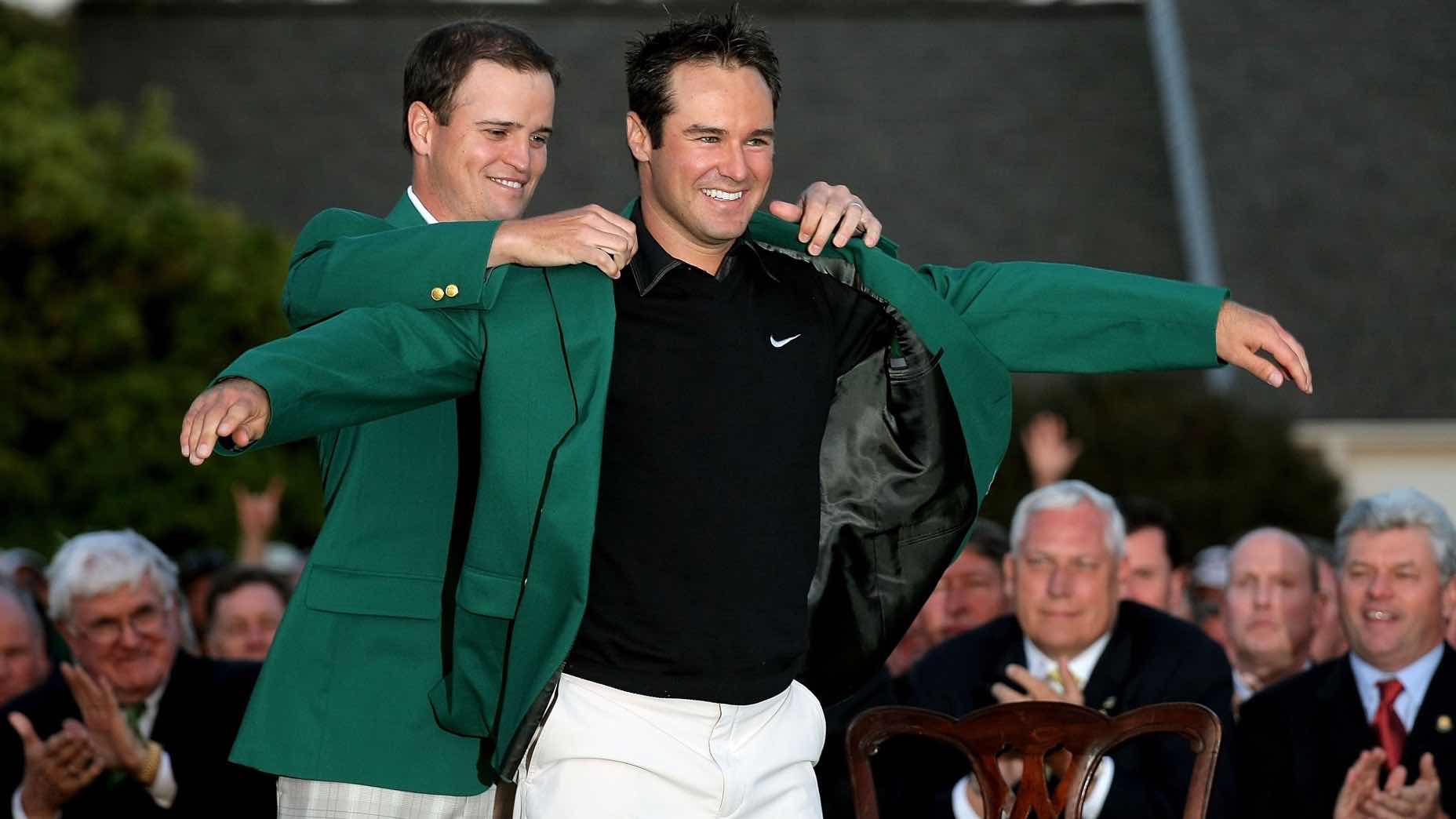
The moment arrived as it has for many Masters champions: Seated in a chair in Butler Cabin with a camera pointed in his face. Immelman remembers the euphoria he felt as Jim Nantz presented him with a green jacket, but mostly he remembers a different emotion as it slipped over his shoulders: Bewilderment.
“I remember putting on the green jacket in Butler Cabin and having no idea what was going on,” he says. “And then Nantz says, ‘I’m here with the 2008 Masters champion.’ I wanted to stop looking at the camera and look at him and scream, ‘What?!'”
He’d spent his whole life preparing to win a Masters, but he hadn’t spent a second preparing to celebrate it.
Immelman could be forgiven for his disbelief: the first dream seemed plenty unrealistic on its own, particularly when he approached his parents as a six-year-old to tell them about it for the first time.
“For some reason, I believed it was there for me if I put the work in,” he said. “I took that literally and personally. Before I was 10, every minute of my day was spent thinking about how to be better.”
Immelman was barely a toddler when made himself a promise that he would spend the rest of his life trying to keep: A promise that he would never be outworked on the path to greatness. He knew then that he might not find success thanks to raw talent or skill, but he would not find failure on account of his work ethic. By the time he was 20, he’d booked a one-way ticket from Cape Town to London and started his ascent up the ranks of pro golf — from the Challenge Tour to the European Tour to the Korn Ferry to the PGA Tour.
Immelman can’t really explain the origins of his competitive intensity — only that it isn’t driven by fear. He insists he does not feel anxiety when he thinks about navigating through life without preparation, more a deep kind of discomfort.
“If I decide to do something, it’s like totally all there is,” he says. “I don’t know why, but I just get totally obsessed.”
On the night of his Masters victory, Immelman felt restless. After a raucous after-party, he returned home and waited for the disbelief to fade into the glow of victory, but it never came.
“I went to bed at four and sat wide awake for two hours, just trying to fathom what was going on,” he said. “Finally, at six, I was like ‘I’m wasting my time.’ I got up and started drinking coffee.”
Trevor learned something that day that has lived with him ever since: No amount of external achievement can buy inner peace. He also learned something about himself that has proven quite critical to all that has happened since: No trophy — not even the green jacket — feels as good as the journey to get there.
“You know what’s funny?” He says now. “I’ve learned something over the years. The part of all this that I actually enjoy? It’s the preparation.”
It’s a disposition not unlike the meditations of the legendary philosopher Albert Camus, who suggested Sisyphus — the ancient Greek figure sentenced to roll a stone up a mountain for eternity — must be happy, because “the struggle itself is enough to fill a man’s heart.”
“A lot of people will have dreams like, ‘Oh, I want to be a millionaire,’ or ‘I want to drive a Ferrari,'” he says. “I, for some reason, felt like the ability to play on the Tour and play in majors. It was tangible, it was there for me, if I put the appropriate work in. That’s why I loved it.”
Every year, Immelman takes a moment to reflect upon that first Butler Cabin interview with Jim Nantz. He thinks about the emotions that cascaded over him as the cameras pointed in his face, and about the new life that started in that moment.
He takes a long look into the same camera, from the same chair, next to the same Jim Nantz, in the same Butler Cabin, at the same Masters Tournament.
And then, gloriously, Trevor Immelman gets to work.
“I KNOW THIS SOUNDS CRAZY…” Trevor says, pausing for long enough to catch my eye. “But I love it. I actually love it.”
It’s an hour and change into our meeting at the coffee shop that Adam Scott likes, and Immelman is hitting his stride. The conversation has shifted from grilling to a subject of a more predictable variety: work.
“How and why. How and why,” he says. “How did they do that? Why did they do that? Why did they hit a bad shot? Was the lie awkward? Was there mud on the ball? Was he between clubs? Did he not want to go left because there’s water? How and why. That’s what I’m thinking all the time.”
In his second life as the lead analyst for CBS Golf, Immelman has earned a reputation as an unusually straight shooter. At the Genesis Invitational in February, the CBS Golf team hosted Tiger Woods for an on-camera interview about the rest of his season. When Woods tried to answer coyly about his Masters availability, Immelman held his feet to the fire.
“Is there a possibility you might play at Augusta?” He said, eliciting an unusually candid answer from the 15-time major champ.
Immelman’s persona is unusual in this way: unyielding on the things that really matter, even if they are personally inconvenient. He describes his on-camera ethos simply.
“I may not always be right, but I’m going to have the guts to tell you what I think.”
“Was I the greatest player in the world? No. I don’t ever pretend to be,” he says. “But I’ve seen a lot of things in the game, experienced a lot of things in the game, and I study it probably more than anybody. So I’m going to tell you what I think, and I’m going to leave it up to the viewer to decide if they agree with me or not.”
Immelman makes that work sound simple, but it rarely is. There are only so many people on earth with his on-camera ability. Of that group, only a handful have Immelman’s major championship pedigree, and only one has his work ethic.
What does it mean? His old boss at CBS Sports, Sean McManus, puts the totality of this skillset more bluntly.
“I really believe that when it’s all said and done, he’ll be the best golf analyst in history,” McManus says.
As he finished up at the coffee shop, Immelman’s mind returned to the work. “I don’t even know if I’m good at this yet,” he admitted. “But I’ve realized quickly that I thoroughly enjoy it.”
Recently, he said, he’s started testing out a new theory about his path to television. “There’s a large part of me that thinks this is actually what I was supposed to do with my life — the playing was basically just preparing me for this,” he said.
As he turned the idea over in his head, the Masters champ seemed exhilarated by this admission, and maybe a little scared.
It was early in the day for another surprise, but what the hell?
You can reach the author at james.colgan@golf.com.
The post How Trevor Immelman found his higher calling appeared first on Golf.