Before he lost 100 pounds and gained a million followers, Nick Stubbe was a beefy ex-collegiate golfer with an office job and an Instagram account on which he rarely posted. Weekdays, he worked as an accountant. Weekends, he knocked it around with friends on a rota of courses in Richmond, Va.
The routine suited the easygoing Stubbe, who liked his colleagues and loved his golf, playing to scratch with a buttery swing and a beer-league body that made him look as if he’d stumbled to the first tee from a tailgate. What he didn’t look like was a budding social media star, which was fine by him because he wasn’t trying to become one. The sponsorship deals, celebrity pro-ams, viral videos with Bryson DeChambeau — none of that was part of any plan because, well, there was no plan.
“I was not an unhappy person looking for my way out,” Stubbe says. “It all just sort of happened.”
Fame may have arrived from out of nowhere, but Stubbe has since rearranged his life around it. Just over two years ago, he moved to Palm Beach, Fla., closer to the year-round golf action, where he resides in a two-story home so tidy it seems almost staged.
“You can thank my assistant for that,” he says.
It’s late morning, and Stubbe, a night owl, is just getting started, camped out on his couch in a T-shirt, shorts and slippers. A flat-screen TV is tuned to Golf Channel, but Stubbe is gazing at his phone, scrolling through a two-day backlog that accumulated while he was in New York for a media outing at Shinnecock, followed by an LPGA pro-am in New Jersey. During that time, hundreds of DMs poured in, many from strangers extending invitations to their private clubs.
If you’re still in the area, come out to North Jersey Country Club.
How about 36 at Fiddler’s Elbow tomorrow?
None of the messages addresses him by his real name.
“Only my mom still calls me Nick,” Stubbe says.
To most everyone else, he is Fat Perez, accidental star of the YouTube juggernaut Bob Does Sports, and one of the most recognizable faces in an online explosion that has brought golf, in one form or another, to millions of new fans and minted a new breed of celebrity in the process.
“It’s a little weird because I feel like I’m the same guy I’ve always been,” Stubbe says. “But then someone will recognize me in an airport.”
Golf has a rich history of household names. Ben Hogan became a brand. So did Arnold Palmer. But something different has swept through the game, and it didn’t start on Tour or in the corridors of power that have traditionally shaped golf’s image. It came from YouTube and Instagram, from golfers of all stripes with cameras and an instinct for what plays online. A younger demographic has grown up knowing the likes of Grant Horvat and Gabby Golf Girl the way earlier generations knew Jack Nicklaus and Tiger Woods.
The impact on the industry has been profound. Brands that once spent their budgets sponsoring high-profile pros now cut checks to creators with no Tour status but legions of followers. Courses that once kept cameras at arm’s length are hosting content shoots. Exactly when it started is a source of debate. Though the English pro Rick Shiels is often cited as the “godfather of YouTube golf,” his instructional content was predated by that of his countryman Mark Crossfield, whose swing tips and gear reviews gained online traction as early as 2007. Three years later, Blair O’Neal announced herself as a public figure by winning Big Break Dominican Republic, a victory she parlayed into her own digital platform. The following decade brought a wave of personalities: Paige Spiranac, the Bryan Bros and on. In retrospect, a swell was building, but it took a pandemic to break the dam. With the Covid golf boom, the wave spilled into every corner of the game, where a captive audience awaited.
The content that audience consumes today spans a dizzying range, from traditional instruction to trick shots, challenge matches, golf-cart stunts and thirst-trap snippets. As with all things internet, skin sells, and some female creators have leaned into that market. But on the women’s side, there’s plenty of substance amid the sex appeal — serious instruction, travel vlogs and more. Many guys, meanwhile, have gone the opposite direction — more beer bong than beefcake — tilting toward a bros-gone-wild form of branding. To watch a lot of it is to feel like a fly on the wall of a raucous buddies’ trip, replete with boozy nights and pranks that pass for fraternity hazing. If golf’s original showman, Walter Hagen, were still around, he might be surprised to learn that the sight of four guys trying to inhale 60 tacos while playing nine holes now counts as entertainment. And doubly surprised to discover that one of the participants in that video was Jon Rahm, binge-eating alongside Fat Perez.
There was some imposter syndrome in the beginning,” says Fat Perez. “I thought, Why me? I don’t deserve this. It’s just luck.”
Rahm’s cameo captured something undeniable about the current moment: the growing intersection of traditional golf and creator golf, in ways that would have seemed impossible a few years ago. The PGA Tour has staged Creator Classics and signed Good Good — a YouTube collective with more than two million followers — as a title sponsor of a Tour event in Austin, while creators have built increasingly polished competitive circuits of their own, culminating in events like last year’s Internet Invitational, which drew 25 million views across six YouTube episodes.
Major champs move easily between the eco-systems. DeChambeau, among the pro game’s most magnetic stars, has openly discussed becoming a full-time YouTuber. But the convergence has also caused tensions. Wesley Bryan, who runs a popular YouTube channel with his brother George, was suspended by the Tour after appearing in a LIV-backed influencer event. Even Augusta National, the most self-assured of institutions, has seemed uncertain how to walk the line — a point conceded by club chairman Fred Ridley when he noted that letting the dudes from Dude Perfect fling Frisbees around Amen Corner “may not have been the best idea.”
The partnerships keep multiplying anyway.
“To my mind, traditional golf and creator golf are complements, not competitors,” says Zach Long, an agent who represents several prominent creators. “They feed off each other.”
Whether both sides benefit equally is another matter. Some industry observers question if audiences skewing young and cash-light convert into paying customers, just as course operators wonder if it’s worth it to oblige every influencer asking for a freebie in exchange for posts. But skepticism has done little to slow the money or momentum.
The sums at stake help explain the frenzy. Top creators can pull in high seven figures a year, while others lower on the food chain still earn handsome incomes supplemented by lifestyle perks: free equipment, comped rounds, lavish resort stays. It’s no wonder the internet is bursting with aspiring influencers.
“It’s the Wild West,” says Robbie Wooten, owner of Golf Creative Co., a golf marketing agency. “It looks sexy to these kids, but most will find it takes a tremendous amount of work and a great grind to always innovate and create.”
“I WANT TO GO VIRAL in people’s souls,” says Leo Herrera.
Fifteen minutes south of Stubbe’s place, Herrera is standing on a custom putting mat in his sparsely furnished apartment, laptop open, forehead shiny with sweat. He’s just finished teaching a live-stream class on golf fundamentals to 17 paying students — $67 a head for the hour. It’s one of several revenue streams Herrera has established beneath the digital umbrella of the Connected Golfer, a mind-body brand blending instruction, fitness, philosophy and mental health.
“I’m starting to figure out how to make a living at this fully,” he says. “But it has taken a while.”
Unlike Stubbe, who all but wandered into internet fame, Herrera has approached content creation with the type-A focus of a start-up founder. At 24, he speaks in paragraphs about audience growth and storytelling, mixing golf terminology and marketing lingo. He’s been fluent in the former since childhood.
Born and raised in Miami, Herrera was a standout junior player who dreamed of becoming “the best golfer in the world.” He earned a scholarship to the University of Central Florida but dropped out after a year, disillusioned by what he regarded as a toxic environment while still harboring ambitions of turning pro. Two weeks later, he and a friend won the U.S. Amateur Four-Ball Championship, a clutch performance that only complicated his thinking about what came next.
“I knew I wanted to make a life in golf,” he says. “I just didn’t know how.”
This was 2021. Lockdowns were in full force and YouTube golf was beginning to boom. The more Herrera watched the likes of Horvat and Good Good, the more he saw an alternate route into the game.
“I decided to go all in on myself as a brand,” he says.
Like many aspiring creators, he started by mimicking formats that already worked: challenge matches, swing tips, comic bits. Some posts fizzled, others caught fire. In one clip, Herrera demonstrated how to “brush” the grass on chip shots while repeating the Spanish word for brush. The video spiked. His follower base swelled. Nearly 140,000 people track him on Instagram today. But followers alone are not a business.
“They are useless if you can’t capitalize on them,” Herrera says.
Monetization required investment. Herrera’s parents pitched in to purchase camera equipment, editing software and an inventory of Connected Golfer merch. Their son enrolled in business seminars and consulted marketing strategists, mapping a plan to turn his output into a profitable enterprise. The blueprint he developed is scrawled on a whiteboard in his apartment. After several lean years, the operation has only recently become self-sustaining, Herrera says, with projected revenues north of $100,000 this year.
My goal is to get to the point where I’m live streaming 24-7, and people are with me all day,” says Herrera.
That covers the costs; it doesn’t account for the sweat equity. On this weekday alone, Herrera’s schedule begins with a 6 a.m. meditation session and gym workout — he films this on his phone, posting Instagram stories between sets — before a video shoot at a nearby driving range, a podcast recording and a call with a brand strategist. By early evening, he arrives at the Park West Palm, a recently reimagined municipal facility that has become one of the gravitational centers of South Florida’s creator-golf scene. Part practice ground, part social club, part content incubator, it hums in the fading light with young golfers filming swings beside piles of range balls, iPhones propped on selfie sticks.
This is where Herrera’s orbit gathers. Familiar figures are milling about. Herrera embraces Jared Civin, 22, a.k.a. the Headband Golfer, a recent college grad who posts on Instagram with a smile on his face and a strip of fabric wrapped around his forehead. Nearby is Jordan Douglas, who goes by JTD Golf. He is 27 and recently relocated from Maryland, having left a full-time job at a private club to devote himself to content creation. He is living with family and has no fallback plan.
“My feeling is that if you have a plan B, you’re not really committed to your plan A,” he says.
When everything is potential content, can you ever put your phone down? Some creators would rather not.
“My goal,” Herrera says, “is to get to the point where I’m live streaming 24-7, and people are with me all day.”
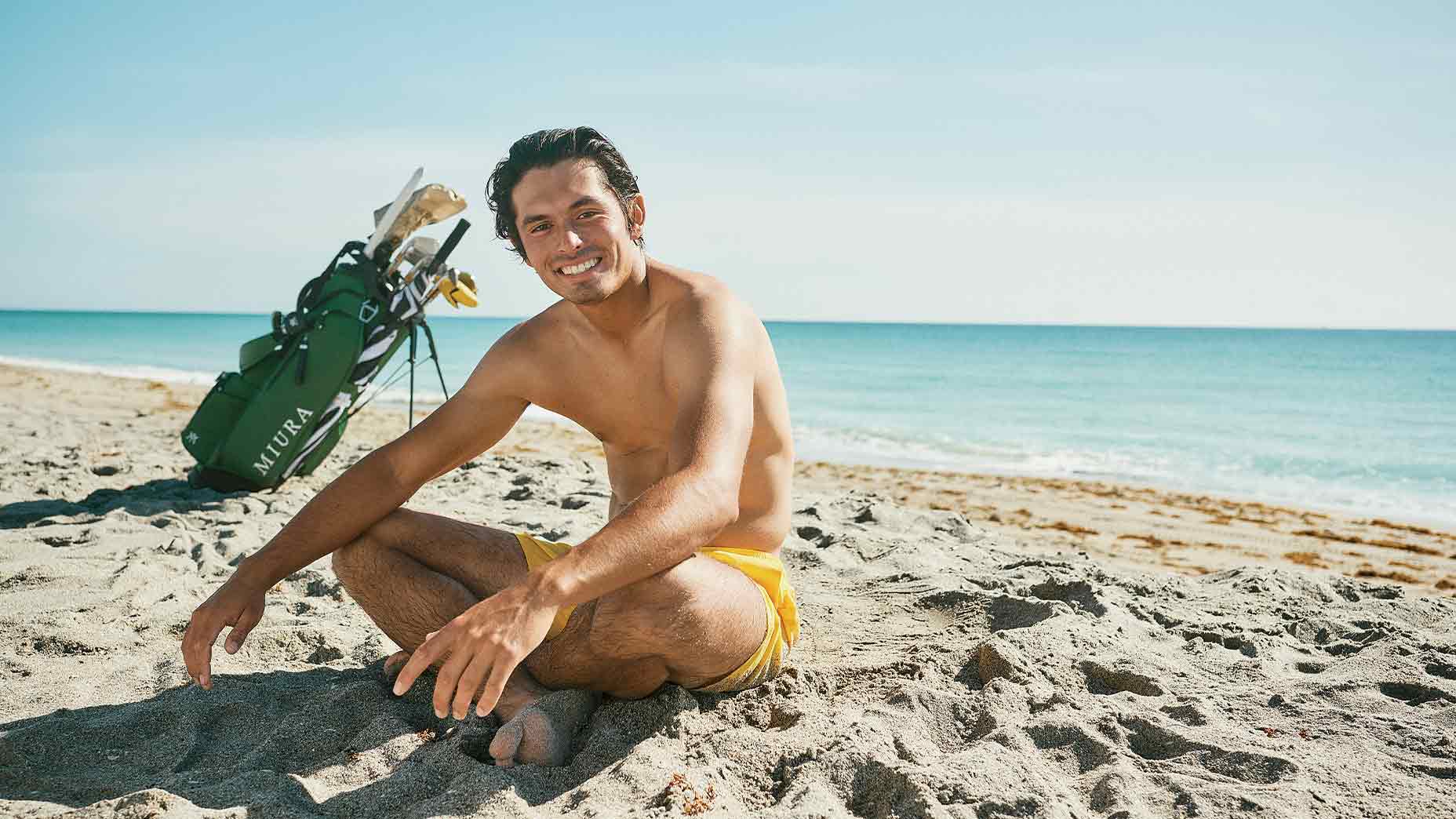
Fat Perez vibrates at a different frequency. Where Herrera attacks his schedule with intensity, Stubbe has the Jimmy Buffett air of a man ready to roll with whatever comes his way. His reality, though, is more structured than that.
Two weeks a month, he’s on the road with his Bob Does Sports costars, Robby Berger and Joey “Cold Cuts” Demare, filming six YouTube videos in tightly scheduled bursts of golf, gambling, booze and banter. Days stretch late. Call times come early. There are flights, sponsor obligations, strategy meetings and a steady flow of content shepherded by three full-time producers.
Off weeks in Palm Beach are less regimented, but Stubbe makes a point of staying busy. He works out regularly, part of a health kick that has helped him shed nearly 100 pounds while earning him fresh nicknames: Fit Perez. Flat Perez. Eating challenges remain a job requirement, but in his slimmed-down form they’ve gotten hard to stomach.
“A dozen doughnuts in nine holes is just disgusting,” he says of a recent stunt.
New habits notwithstanding, Stubbe’s lifestyle is hardly spartan. Afternoons often find him floating on a friend’s boat along the Intracoastal. He’s a regular at Ralph’s, a local dive bar he favors for its dartboard and stocked selection of Have a Day, a line of canned Bob Does Sports–branded tequila cocktails. And he plays golf. Lots of golf. Even when the cameras aren’t rolling.
“I can’t get enough,” he says.
That’s what he was doing during Covid in Virginia, beating up on an opponent so badly in a match that the guy took to calling him Fat Perez — a nod to Stubbe’s skill, build and hair, which he’d grown into a mullet, not unlike the ’do of Tour pro Pat Perez. Not long after, Stubbe signed on as Fat Perez to a Zoom happy hour with Berger and Demare, who’d recently launched the channel that would become Bob Does Sports. They dug the Fat Perez moniker and laid-back demeanor of the man behind it. One thing led to another, which led to a chance meeting at Pinehurst, where they grabbed a beer, then played a round together.
The chemistry crackled. Soon enough, Berger and Demare invited “FP” to join them as a ringer in a challenge match against Barstool Sports. A corpulent cult hero was born.
“There was some impostor syndrome in the beginning,” Stubbe says of his vault to stardom. “I thought, Why me? I don’t deserve this. It’s just luck. But over time, I’ve allowed myself to take some credit for getting to where I am.”
At times, the transformation still takes him aback — as when, for instance, he’s banging it around with DeChambeau in a two-man scramble or hobnobbing with the newly golf-addicted LeBron James in a YouTube post that nearly broke the internet. In such out-of-body moments, Stubbe thinks, Whoa, I’m a long way from my normal. That no one watching would ever know it points to the special power of Fat Perez: He and Nick Stubbe are the same.
If his followers are drawn to that authenticity, they’re also enthralled by the sense of access. Scholars have a term for this. Coined in the early days of television to describe the intimate, one-sided relationships audiences form with public figures, “para- social” captures a dominant dynamic in the online content age.
In Palm Beach, it suffuses the atmosphere. Walk into a seafood restaurant with Stubbe and a table of thirtysomethings crane their necks. Show up at a golf course and the bag drop kids abandon their posts. In the pro shop, Stubbe tries to pay his green fees but is waved through. Young people ask for photos and Stubbe is unfailingly accommodating. Real or imagined, a sense of intimacy is central to the brand, and Bob Does Sports is bent on deepening that bond. The company is building out a Florida warehouse into “Bob HQ,” equipped with a hoop court, pickle-ball, Ping-Pong, oversize TVs — off-course digs where their viewing public can “hang out” with them too.
The course, though, is where Stubbe would rather be. Like Herrera, he’s a regular at the Park, and on this early evening he’s ready for a breezy loop on the par-3. Per usual, he allows himself time to linger, to chat with the followers and aspiring influencers who invariably approach him. He’s encouraging of the people he meets, quick to say that there’s still room in what some perceive as a saturated space. It’s been 24 hours since Herrera’s visit, and the Park isn’t as crowded as it was the night before. But as Stubbe steps to the first tee, a single mom sidles up to him and tries Face-Timing her teenage son to show him who she’s met. No answer.
“It would have blown his mind,” she says.
The night wears on. On the practice green, Jared Civin, smiling in his headband, is working on his putting but thinking about his next post. You never know what might go viral, when a favorable bounce in the ether might change everything for him.
“I’ve got an idea for a funny interview I want to do with people on the range,” he says.
Out on the par-3, Fat Perez plays on.
The post How Fat Perez and online creators are cashing in on golf’s digital boom appeared first on Golf.