Attending a post-match press conference after a major international football match can be an eye-opening experience.
It is not often that you get to see a sizeable media contingent gathered in one room, where video cameras are lined up, photographers are jostling for a sweet spot to snap their subject, and journalists are typing away to meet their "off-stone".
When an interviewee cannot speak or understand the language used at the presser, an interpreter plays a vital role as a bridge between the subject and the media.
"HIT-AND-MISS"
To date, the most impressive interpreter I have seen was one working for a Portuguese-speaking coach; he carried out his job almost flawlessly without taking a single note beforehand, translating the entire speech into English effortlessly.
Having said that, I have also witnessed a few slip-ups—such as an occasion when an interpreter misinterpreted a question and had to be corrected by the journalist before relaying it to the interviewee.
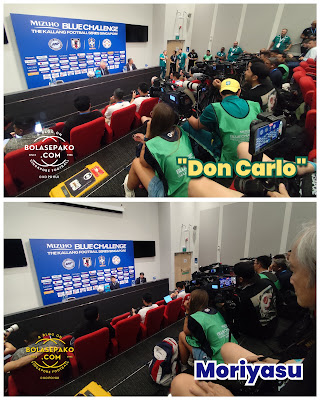 |
| The post-match presser of Ancelotti and Moriyasu on 14/11/26 at National Stadium |
The most recent post-match presser I attended was for the Mizuho Blue Challenge match between Japan and Brazil at the National Stadium a few days ago.
Usually, it is the designated away side's turn to face the media first before making way for the designated home side.
"DON CARLO" AND MORIYASU
In this case, "Don Carlo" (Brazil coach Carlo Ancelotti) presided over the proceedings, taking questions from the floor and replying in either Spanish (I presumed) or English when addressing the local media.
Soon after, Hajime Moriyasu took his seat on the stage, flanked by an interpreter on his left. The soft-spoken, outgoing Japanese head coach answered at length to questions from the non-Japanese media before taking those from the Japanese reporters.
MISSED OPPORTUNITY
Regrettably, the interpreter did not take the initiative to translate those Japanese questions and answers for the rest of the room who do not understand the language.
For the non-Japanese press in the room, it was a missed opportunity to hear the full context of Moriyasu’s thoughts in his native tongue — and a reminder of just how much difference a proactive interpreter would make when the cameras are rolling. Just a thought.