WASHINGTON, D.C. — Judge Ana C. Reyes might be helping decide the future of the beloved D.C. muni, East Potomac Golf Links, but she decidedly is not a golfer. “A good walk ruined,” is how Reyes jokingly describes the game, borrowing from a line often incorrectly credited to Mark Twain.
Still, even a non-golfer surely could have appreciated the spectacular golf weather Monday brought to the nation’s capital: high 60s, cloudless, just a hint of a breeze — the kind of conditions that might tempt you to bolt from work to the course and play until gloaming fades to darkness, as golfers did by the dozen Monday at East Potomac.
We’ll return to that joyous scene in a moment, but first, a pit stop to the 4th floor of the E. Barrett Prettyman U.S. Courthouse, just around the corner from the Capitol Building and less than three miles northwest of East Potomac. Courtroom 12 is Judge Reyes’s domain, and if you’re into legal clashes, there was no better place to be Monday at 10 a.m.
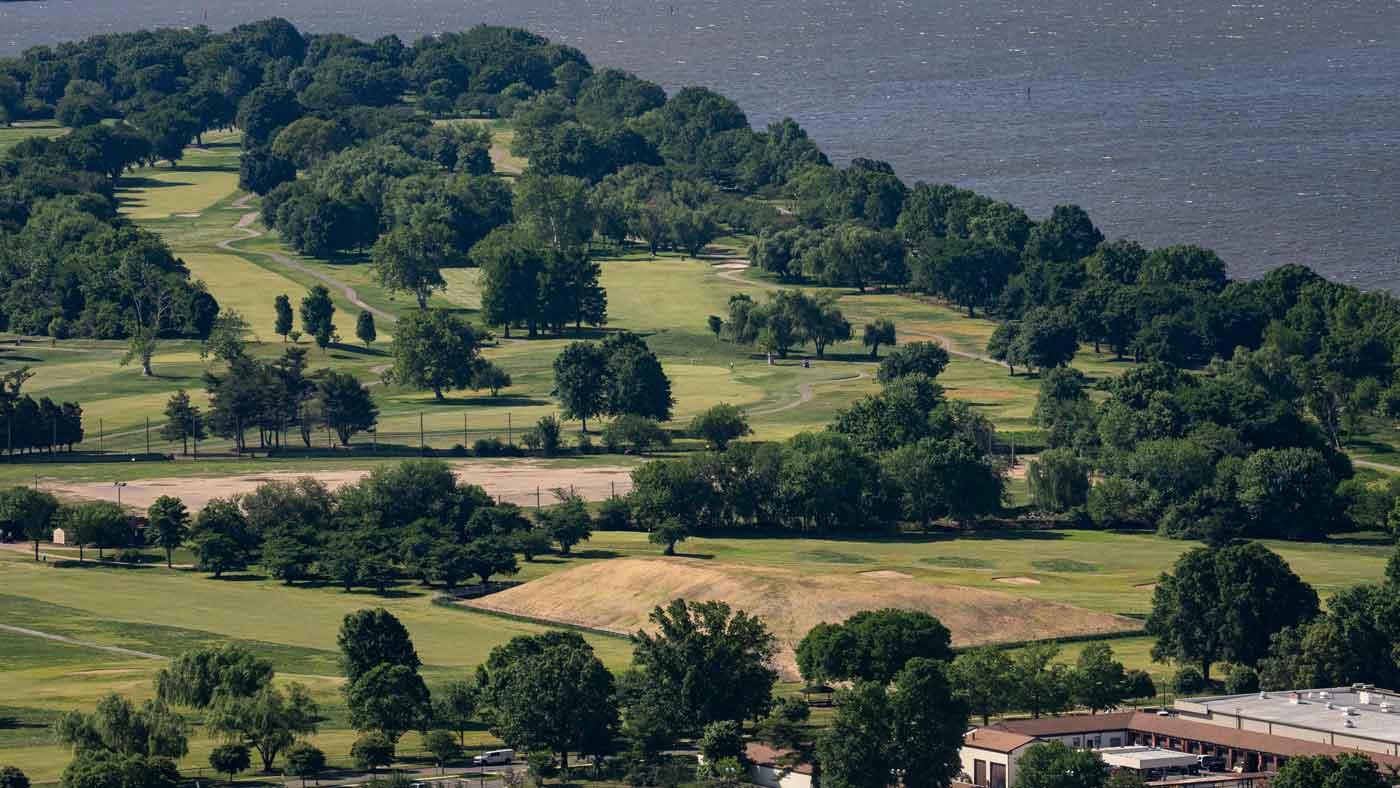
That was the hour at which a standing-room-only gallery rose to greet Reyes as she kicked off the latest hearing in the contentious case that will, in theory, decide next steps for East Potomac Park, a 330-acre manmade peninsula that houses, among other green-space splendors, waterfront jogging and biking paths, a cherry tree grove and three golf courses, including the 18-hole Blue Course, a Walter J. Travis design that dates to the Gatsby era and can be played for less than 50 bucks.
To the swelling team of politicians (President Trump chief among them), bureaucrats and lawyers committed to seeing the park remodeled into a singular 18-hole golf course capable of hosting A-list tournaments, Reyes has become an inconvenience. So much so that on Friday the Department of Justice demanded that the 52-year-old Uruguay native, who made headlines for berating a government attorney at a hearing on Monday of last week, recuse herself from the case for “violating the basic norms” that a judge remain impartial. President Trump, in a Truth Social post Monday morning, doubled down on the Reyes rebuking, alleging: “The judge on the case is a crazed lunatic whose courthouse tapes will reveal, may be insane?”
***
ALAS, REYES DID NOT step down. There she was, back at the bench Monday, American flag to her right, witness stand to her left, Diet Coke never out of reach. If the government had hoped its request would have a chilling effect on Reyes, it instead seemed only to further steel her. As had been the case in the Oct. 12 hearing, Monday’s session — which included testimony, as ordered by Reyes, from Interior Department official Gregory Wischer and acting Director of the National Park Service Jessica Bowron — teemed with more jabs, sighs and scoldings from Reyes, and not only directed at the defense. Reyes, who controls her courtroom like Scottie Scheffler does a 7-iron, also reprimanded the plaintiff’s lead lawyer, Abbe Lowell, for meandering questions.
Reyes’s continued exasperation with the government largely was fueled by its refusal to acknowledge that the Parks Department’s Oct. 10 felling of more than 400 trees on the Blue Course was motivated by the president’s vision for the site and not, as the DOJ claims, by a 2019 Cultural Landscape Report that included a series of renovation recommendations, including tree management, that would improve conditions at D.C.’s three municipal courses, East Potomac, Rock Creek and Langston. That distinction is important, because if the tree removal had not already been authorized, the Interior Department would have been obligated to secure permits and court approval before beginning work.

Seemingly undercutting the government’s argument that the tree work was not tied to the course renovation were Sunday-into-Monday social posts from the president in which he said that “the Department of the Interior, under the auspices of Secretary Doug Burgum, and in conjunction with famed Golf Course Architect, Tom Fazio, has developed a plan to build a World Class Championship Golf Course on the site of the current East Potomac Golf Links,” adding that the course would close Nov. 15 for a 15-month construction project. On Monday morning the president followed with another post in which he said, “The experts at ‘Interior’ are allowed to do this First Class renovation ‘as of right.’ They do not need an approval. Work is scheduled to begin IMMEDIATELY!”
Throughout the Monday hearing, Reyes and Lowell, the plaintiff lawyer, struggled to square the defendants’ claim of still-undecided site plans with Trump’s far more urgent and specific messaging.
“Do I believe the president of the United States or do I believe you?” Reyes said to the defense team, led by Associate Attorney General Stanley E. Woodward, Jr., the DOJ’s third-highest-ranking official.
Reyes later said: “I have, on the one hand, the president of the United States saying to the American public three times now, I think, in the last two days, there is a final plan to redesign the golf course. Then I have you all telling me and, you know, witnesses saying what they’re saying, that there’s no final plan. Which is it?”
Reyes never got a clear answer to a topic that has been of great interest not only to D.C. golfers but also local bikers, joggers, walkers, anglers and picnickers, many of whom were alarmed by the latest plan for the site, which shows the golf course subsuming, among other public-access property, the roadway that lines the perimeter of the peninsula. Among the onlookers in the courtroom Monday were a group of bikers, a couple of whom had their helmets clipped to backpacks and one of whom was clad in a cycling jersey. In the row behind them was David Hearn, a three-time Olympic kayaker and noted Trump foil, who has been one of the park’s most vocal supporters.

Though Reyes has had little exposure to golf, she is well aware of East Potomac’s significance to the D.C. golf scene. Toward the end of the seven-hour proceeding, she told a defense lawyer of the proposed Interior Department redo, “It’s not just a golf course design, counsel.” The Blue Course, Reyes reminded the lawyer, was one of the first public golf courses to be desegregated and is a protected historic landmark. “This is not just some putt-putt course,” Reyes said.
The hearing wrapped without a decision. Reyes said she still was considering whether to stop or curtail work on the course and, if so, to what extent.
The judge also used her closing remarks to reveal an unsettling result of her oversight of the case. “A federal judge is getting death threats over a golf course,” Reyes said. “I really don’t think that’s what the founders envisioned.”
***
REYES ADJOURNED THE COURT at just after 5 p.m. If you had zipped down to East Potomac Golf Links at that hour, you would have found a scene — in spirit, anyway — surely more in keeping with what the park’s founders had envisioned. The sun melting over a half-full driving range. A girls’ golf team from a nearby high school gleaning counsel from their coach on a practice green. Players of all ages and abilities enjoying rounds on the three courses followed by cold drinks in white Adirondack chairs by the clubhouse.
Among the locals soaking up the idyllic evening was Brian Kelly, a retired journalist, who wore a Washington Senators hat low over his brow as he worked through his game on the range. “The value of this place is the cross-section of people who play here,” Kelly said after his practice session. “Kids, kids with their parents, old guys like me playing on a Tuesday morning. Weekends are just packed. It’s a real important facility for D.C.”
None of which is to say East Potomac is perfect. The fairways are patchy, the course has severe drainage issues and the wooden driving-range bays are rundown (even if they are outfitted with shot-tracking technology). The place objectively needs some love. As for the sycamores and willows lining the fairways, at least some East Po’ regulars agree that the property would benefit from removing some of them. “It’s not really a bad thing,” Kelly said of the trees that came down on Oct. 10, “because a lot of these trees shouldn’t be here.”
From the vantage point of the clubhouse, it’s hard to tell that any work has been done. The felled trees don’t begin to come into focus until you arrive at the overgrown swath to right of the par-4 2nd hole, which was a focus of the government’s work over Columbus Day weekend. A massive amount of brush has been cleared out there, and dozens of trees — what Wischer, the National Park Service director, referred to Monday as “overgrown saplings” — now sit in stacks next to sawed-off stumps. Further out on the course, more tree work is evident, with larger oaks and maples lying horizontal along the fairways, their jagged stumps exposed. “Not exactly specimen trees,” Wischer said in his testimony. “These weren’t trees like in your front yard.”


At issue in the courthouse, though, isn’t so much the removal of the trees but rather the process by which the government has conducted the work. “Questions abound,” Reyes said.
Chase Castle, an East Potomac regular who frequently stops to play the course after work, said Monday that he’d received a handful of messages from out-of-town friends inquiring about the president’s plans for the property. What does Castle tell them?
“I tell them it’s disgusting,” he said. “I hate it. It’s disappointing. It’s bad for golf. Much fewer people are going to be able to use this in the future when it’s only one course.”
The plan also worries non-golfers like Konyka Dunson, a facilitator and leadership trainer, who on Monday evening was writing in a notepad on a table outside the clubhouse. Dunson said she has been coming to East Potomac Park for 25 years. She walks on the park’s waterside paths and calls East Potomac her “sacred space.” Dunson said she has been struggling to wrap her head around the proposal for the site.
“It never occurred to me that the National Park Service wouldn’t protect a national park,” she said. “And it’s not just this thing like, Oh, it’s just a golf course. It’s way more than that. People have picnics here. People have had weddings. I see people praying here. You see people biking. I have walked miles here. I’ve seen people even do celebrations of life and release balloons. You see all kinds of things. To take away something that means so much to so many people…”
Dunson didn’t finish the thought but she didn’t need to.
“It’s unfathomable to think this could actually happen,” she said. “I sincerely hope it does not.”
It was dark now but the last of the golfers were still milling about. If you couldn’t see them, you could hear them, their clubs rattling in their bags as they walked off the range, past the lighted practice green and to the parking lot. It had been a good day at East Potomac. Less clear is how many more days will look and feel like this one.
The post The war for East Potomac: Inside golf’s most heated battleground appeared first on Golf.