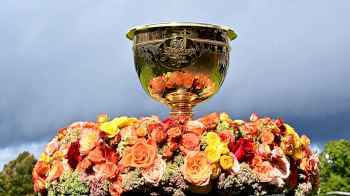
In the end, the 2026 Presidents Cup was an exercise in extremes.
And in the end, American dominance in singles play outweighed its ineptitude in alternate shot. After several stressful, underwhelming days from the home team reignited years-long debates about American match play preparation and team strategy, a 9-2-1 performance on Sunday at Medinah reminded us that, in the end, the best way to win at team golf competitions is to have the best players. If there was any doubt before the competition began in Chicago, there is no doubt now: the Americans are the more talented side.
Every year, team play competitions are an opportunity for the sport to take stock of itself. Is the American crop of talent as good as it looks on paper? Has the golden generation of International talent aged into a formidable threat to American dominance? Who are the young stars that will come to define the next decade of the event?
This Presidents Cup was no different. And with those thoughts in mind, let’s take a second to grade each performance.
It sounds crazy to say, but of all the players in the field at this Presidents Cup, Scheffler was the one with the most to gain. The World No. 1 has been a largely disappointing player in team events, twice losing all four of his “partner” sessions in the Ryder Cup and generally falling well below his typical standard in strokes gained data and birdies made.
At the Presidents Cup, Scheffler appeared more comfortable in four-ball, winning both of his sessions alongside partner and buddy Sam Burns, but still proved a liability in alternate shot, losing his one and only appearance as part of the International tidal wave on Friday afternoon. U.S. Captain Brandt Snedeker made perhaps the boldest move of his entire captaincy on Saturday morning when he benched Scheffler for the afternoon’s alternate-shot session, “resting” him for Sunday. Then, the most important player on the American side eeked out an important but decidedly tenuous victory over arguably the weakest player on the International side, Nico Echavarria, in Sunday’s singles session.
Ultimately, his record for the week was 3-2-0, a solid performance for the U.S. side, but not enough to fully silence questions about his play ahead of next September’s visit to Adare Manor.
It’s been four years since Tom Kim first burst onto the scene at the 2022 Presidents Cup at Quail Hollow, and it feels like he hasn’t missed a putt of shorter than 20 feet under the International flag in that time.
Kim finished well below his singles counterpart, Wyndham Clark, in DataGolf’s strokes gained data for the weekend. And yet it was Kim who showed up when it mattered most, delivering a 3-and-2 victory for his fourth point on the International side, a team high.
Snedeker deserves credit for keeping the team room together after a disaster start to the event. He also deserves a good amount of the blame for that disaster start … and for the numerous (self-professed) follies and screw-ups that followed it, including an apparent hour-long commute from the team hotel in downtown Chicago.
Think about the best Ryder and Presidents Cup teams you’ve ever seen. Think about the way their leadership operated. Did they seem in control? Did they seem to have a plan? Did they stick to the plan? When they deviated, did it seem calculated? Did they seem prepared? And how about their players?
Now think about what you saw from Snedeker and the U.S. side this week. Did anything this team did make you feel better about its chances of contending against a much more formidable European side in 12 months? Being a captain is a tough job, but this performance was not one for the record books.
View this post on Instagram
Burns finishes the week with two four-ball victories alongside Scottie Scheffler … and not much else. After a season in which he seemed to ascend to the upper echelon of players in the world, his Presidents Cup instead served as a reminder that he has work to do before he fully gets there.
Anytime you lose more than seven shots to the field tee-to-green in the span of just two rounds of golf, you’re not having a very good time. Nico Echavarria did not have a very good time at Medinah, struggling in a very limited showing for the Internationals. He saved himself from a full failing grade for his rally down the closing stretch against Scheffler on Sunday after the ugliness on the 14th tee box, but it certainly wasn’t the weekend he dreamt of in Chicago.
Cam Young is quickly developing into a serial killer in these team settings. In addition to Bethpage last year, Medinah marked two straight events where he’s been the best player on the U.S. side by a few miles.
He’s a legit star player who elevates when playing under the flag. Looking at the rest of the prospective U.S. Ryder Cup roster, that’s a rarity — and a major addition.
Sungjae Im was equally brilliant for the INTs, delivering a rare black flag on the board on Sunday when they needed it most. He gets docked a few points for his record — which included a loss to Scheffler/Burns in four-ball despite a late lead, and a Saturday afternoon gut punch from Young and Gotterup in alternate shot.
It’s fair to say we got exactly what we expected from Corey Conners this week. He had some brilliant moments with his irons. He made a huge, clutch putt to close out the Americans in foursomes on Saturday afternoon. That was the good.
He also lost nearly six shots to the field with his putter over the course of the week and gagged on shorties a few times in his blowout singles loss to Justin Thomas.
Sure, Thomas is the heartbeat of the U.S. side. But the Internationals needed an usually good week from Conners if they were going to get over the hump. This week wasn’t that.
This was an all-upside week for the youngest player on the American side. Play a few matches, get your feet wet. Whether things went well or poorly, everything about Koivun’s performance could be chalked up to a learning experience for a vitally important piece of the U.S.’s competitive future.
Well, Koivun instead looked like a superstar, “carrying” his teammate Justin Thomas (in Thomas’ own accounting) in a four-ball win on Saturday morning that kept the competition close — then delivering the clutchest moment of the tournament on Sunday afternoon when he held off Si Woo Kim to deliver the U.S. one of the clinching points to the U.S. side.
In Chicago, Koivun played a crucial role for the Americans … and penciled his name onto the shortlist for next fall in Ireland.
Earned his way onto the team over J.J. Spaun (among others), and enjoyed a nice moment when he officially clinched the U.S. victory on Sunday evening, but didn’t exactly stamp his name onto future Ryder Cup squads with an 0-2-0 performance in foursomes.
Earned his way onto the team over J.J. Spaun (among others) with an early-season surge on the PGA Tour, and did stamp his name onto future Ryder Cup squads, assuming his play holds. Gotterup looked the part of a player the U.S. has been missing over the last several years in these competitions — a true glue-guy with a real sense of the moment.
Definitely big enough for the moment. Definitely a more complete and formidable competitor than he’s been in past Presidents Cups. Was the third-best player in the field by DataGolf’s strokes gained rankings. His only real blemish was losing the match of the tournament to Koivun on Sunday afternoon.
Capable of winning regularly at a team event with his D- stuff. It might not always look pretty, but Thomas is the epitome of a gamer. The golf gods rewarded him this weekend.
He got a lot out of a group at a severe talent deficit, but the same problems that plagued the Internationals at previous Cups came back to the bite them in Chicago. Any strategy for Australia in two years (where Ogilvy would be a terrific captain in a repeat role) should start with fixing singles play.
Three wily vets who were all expected to carry this International side when the temperature ratcheted up on the weekend. Unfortunately, also three wily vets who delivered singles losses on Sunday afternoon to hand the U.S. three decisive points.
The best example of U.S. partner strategy actually working. Cantlay and Schauffele struggled their way to losses in four-ball and foursomes on Friday and Saturday, then showed up in a massive way on Sunday evening with the Cup on the line. Cantlay’s 57-foot birdie putt on the 16th hole on Sunday in particular was the kind of unconscious behavior that has become commonplace for him in this setting.
View this post on Instagram
A spark plug all weekend and one of the team’s best statistical players, but his Cup ended at 1-4-0. If the U.S. needs to lean on him in future team events, he showed he can bring his game. The question remains: Will the wins follow?
A few strong moments, a few strong victories, but ultimately this group will be remembered for losing three massive singles matches on Sunday afternoon as the American comeback roared on.
Was left off the Canadian team in Montreal in 2024 for extremely dubious reasons. Played in his first Cup this weekend and showed exactly why that decision was a mistake. Grinded out a gritty, scrappy half on Sunday evening to go along with two wins in foursomes sessions. Something tells me he won’t be left off the team in Australia in two years.
A week of ups and downs that ended on a high with a big singles win. Morikawa hasn’t always looked like the top-5 player he once seemed destined to become, but he’s proved he can be an asset to the U.S. side.
Russell Henley struggled at the Ryder Cup at Bethpage last fall. He struggled again in alternate shot at the Presidents Cup. He gets the benefit of the doubt for playing almost exclusively in a session in which the U.S. was resoundingly destroyed, but a win in his singles match on Sunday would have made it go down a little easier.
The post Grading every Presidents Cup performance from U.S. comeback at Medinah appeared first on Golf.