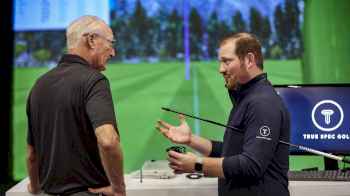
There are few people in golf who know the bunker game better than David Armitage. He coaches all aspects of the game, but the sand is his specialty.
“I am the only guy that is dumb enough to write 144 pages about how to get out of bunkers,” he says.
For most golfers, bunkers are a source of anxiety — a place to be avoided at all costs. For Armitage, the bunker is his happy place. And he wants it to be the same for his students.
That mission has led Armitage to dedicate himself to helping golfers of all skill levels understand the secrets to better bunker play. He has shared his expertise in his book, The Bunker Game: How to Play with Confidence from the Sand, and now in our latest Top 100 Teacher Sessions video, where he breaks down the techniques and adjustments that can turn any golfer into a more confident player from the sand.
Watch the video below or read on for a complete guide to mastering bunker play, courtesy of the man who — quite literally — wrote the book on it.
Just about every average recreational golfer is fearful of the sand. When they see a sand trap, they do everything they can to avoid them, because when they find one, it can lead to a big score.
“I think it all leads back to bad concepts [and] bad understanding of how to play the bunker shot,” Armitage says.
The “standard” technique for bunker play has long been to severely open your stance, open your clubface and then swing down your feet line. However, that technique doesn’t work for a majority of players. With that setup and strike, it requires tons of strength and clubhead speed to get the ball up on the green.
Another issue with this setup is that it makes it incredibly difficult to get the ball heading in the correct direction. With such an open setup, aim becomes quite difficult.
“It’s going to be unpredictable how the ball is going to start,” Armitage says. “Because I’ve got the face wide open, my feet left … I’m not going to be as predictable with my start line.”
For Armitage, the turning point in his bunker education came from one of golf’s greatest short-game artists: Seve Ballesteros.
Armitage spent most of the beginning of his golf life in St. Andrews, where the bunkers are small and difficult to escape. And although he had taken lessons from many coaches, he still struggled with his play from the sand.
“I obviously was a strong young kid and could generate a lot of speed,” Armitage says. “But I found it difficult to start the ball online. I found it difficult to generate distance.”
That changed when he spent time with Ballesteros, who was near the end of his career and visited St. Andrews for corporate outings from time to time. During those visits, Armitage got to watch him hit bunker shots and picked up on some of his techniques, such as the simplicity of the setup.
“He hit all the shots from a square stance,” Armitage says.
Armitage remembers watching Ballesteros demonstrate the shots and heading straight to a bunker to try them himself. The difference was immediate.
“I couldn’t believe how it changed my bunker game and how the start lines became better straight away, how my distance control became better, and how it felt just easier,” he says.
Armitage’s approach to bunker play begins with nailing the setup. Rather than trying to create a complicated swing, he wants golfers to establish a position that makes the correct motion easier to produce.
“I’m looking at really square stance,” he says. “I’ve opened the face. I’m then taking my grip, and then I have a wide stance, low handle, moving my chin, my sternum, and my belt buckle onto the ball or just in front of the ball.”
The first key is getting into a wide stance. Armitage wants it wider than a golfer’s driver stance, which helps lower the body and the handle. That, in turn, helps the ball get up.
He also recommends digging the feet into the sand slightly. This helps golfers feel the sand beneath them and understand what kind of lie they are dealing with. But consistency is important. Armitage doesn’t want golfers digging in by a different amount every time they enter a bunker.
“You’ve gotta be consistent with your approach to that setup,” he says.
The next key is moving the body forward. Armitage wants the chin, sternum and belt buckle to shift toward the target. He sees too many golfers moving their lower body forward while leaving the upper body behind, which moves the low point backward.
“This is a big no-no,” he says.
Instead, the sternum should be forward, with a little more flex in the lead knee. Armitage says this was something he always noticed in Ballesteros’ setup.
For a standard greenside bunker shot, Armitage places the ball just in front of the middle of his stance. The strike point is in the middle, and the sternum is directly above or slightly in front of the ball. That position controls the low point of the swing.
“The club’s gonna enter on the sand, on the line. It gets to its lower point, lowest point where my sternum is, and then it exits out,” he says.
Once the setup is in place, Armitage turns his attention to the clubface. The face still needs to be open, but the reason is different from the traditional approach. He wants an open face so golfers can expose the bounce of the wedge, which helps the club glide through the sand instead of digging into it.
“This is a beautiful part of the club that Gene Sarazen developed,” Armitage says.
The bounce is the part of the sole that helps the club move through the sand. Opening the face exposes more of it, allowing the club to slide rather than dig.
Armitage also points out that golfers need to use the right club for the sand they are playing from. Different bunkers have different types of sand, and different wedges have different amounts of bounce.
“If you have a lot of bounce and you have a hard sand, that’s probably not a great combination,” he says.
For his standard greenside bunker shot, Armitage opens the face to about 2 o’clock. He uses a clock-face reference to explain the position: 12 o’clock is square, 1 o’clock is slightly open, and 2 o’clock is more open. (Left-handed golfers would use the opposite side of the clock, with 11 o’clock being slightly open, and 10 o’clock being more open.)
Armitage also recommends taking the grip after opening the face, which helps keep the face open through the shot.
He sometimes uses a slightly weaker left-hand grip, which helps prevent the face from closing too much. It’s not something every golfer has to do, but it’s a technique that can be useful and that is used by many tour players.
Armitage’s standard bunker shot is 12-yards, which is what another short-game guru, Phil Mickelson, uses as his starting point. All other shots work from that standard 12-yard shot.
For the standard shot, the setup remains the same as described above. Then, the club needs to swing up and down into the sand.
“A lot of people talk about, like, do I pick the club up? Well, I think the club does have to go up,” Armitage says. “Because we do need a steeper angle of attack in the bunker.”
The key is that the setup should make this happen naturally. With the weight forward and the sternum in front of the ball, the club should swing more vertically without the golfer having to force it.
As you approach impact, Armitage wants the clubhead to enter the sand about two inches behind the ball and create a divot pattern that moves slightly left of the target line.If you can do that, the ball should pop nicely out of the sand.
As you make your swing, be sure you keep the weight forward throughout the motion. If you start with 70 to 75 percent of your weight on your lead foot, you wants that pressure to remain there through the backswing and increase into impact. The other important ingredient is speed. The sand slows the club down, so golfers need enough speed to get the ball out.
“Most amateurs, if they hit that shot, they’re out of trouble, they’ve got a putter in their hand, and they’re probably gonna make bogey and move on to the next hole with a smile.”
Once golfers understand the basic bunker shot, you need to learn how to change distance without changing the swing speed. For that, Armitage suggests using different wedges and different face positions.
He has a gap wedge, a 54-degree wedge and a 60-degree wedge. With each club, he can use a square face, a 1 o’clock face, or a 2 o’clock face. That gives him nine different shots without changing the swing speed.
The type of sand, how much sand is taken, and how the club deflects through it can all affect the trajectory. Armitage points out that tour players don’t always create spin themselves. Sometimes the sand is responsible for the way the ball reacts.
“When they see a ball spinning, they think that the player’s making it spin, and sometimes it’s to do with the circumstances,” he says.
For everyday golfers, the lesson is to focus on the setup and the strike rather than trying to manufacture spin.
Armitage’s advanced bunker shot is designed for experienced golfers who need to hit a short-sided shot or get the ball to stop quickly.
“This is a shot that I wouldn’t teach the everyday golfer,” he says.
The shot begins by opening the face even more. Armitage moves from his normal 2 o’clock position to about 2:30, pushing the limits of how much loft he can create. The more open the face becomes, the more bounce is exposed. But it also means there is less of the clubface available to hit the ball with, making the margin for error even thinner.
For this shot, Armitage also weakens his left-hand grip, lowers the handle and widens his stance even more. Then, he makes the same swing he does for any other bunker shot. The result is a shot that launches higher and travels shorter. That allows him to swing with speed while keeping the ball from going too far.
“You can still have speed, and that ball’s gonna go higher and shorter,” he says.
For short-sided bunker shots, that speed is especially important. Armitage says golfers often become tentative when they are close to the hole, and that can lead to deceleration and leaving the ball in the bunker.
But Armitage also emphasizes that some bunker shots are simply not accessible. Even the best players in the world sometimes have to accept a difficult pin and give themselves a longer putt.
“Some shots are just not accessible,” he says. “You’ve gotta take your punishment sometimes.”
Armitage’s practice philosophy is simple: start with the strike, not the ball.
One of his favorite drills uses a rake. He places it behind the ball so that if he sways or falls back during the swing, he will hit it. The drill helps golfers understand how vertical the swing needs to be for a proper bunker shot.
“If I drift off the ball on the backswing, I’m gonna hit the rake,” Armitage says.
The rake also helps golfers make sure the downswing is vertical and forward. Armitage recommends starting slowly and using the drill to build the feeling of the correct motion.
“Do it slowly,” he says. “Maybe just do it in very slow motion just to get the image and the feeling.”
Another drill comes from Ernie Els. Armitage says Els would draw two lines in the sand, set up wide, and make swings that focused on contacting the sand between those lines. He would then make two or three of those swings before hitting a ball.
“That’s what the pros do, and one of the best players in the world,” Armitage says.
The lesson for amateurs is to do the same. Rather than immediately hitting balls, start by practicing the setup and the strike.
“Do the line drills first, get that impact where you want it, and then take that to the ball,” he says.
The post How to hit better bunker shots: A complete guide to mastering the sand appeared first on Golf.