
For most of my adult life, I have been searching for golf’s hidden gems.
When I joined GOLF’s ranking panel decades ago, that search was productive. Some of the greatest courses in the world were hiding in plain sight. National Golf Links of America did not get the attention it deserved. North Berwick wasn’t even in the Top 100. Chicago Golf Club was admired by architectural devotees but hardly qualified as a household name.
That world has largely disappeared.
Over the last 30 years, golfers have become dramatically more sophisticated consumers of architecture. Rankings, books, websites, podcasts, social media and the ease of international travel have exposed golfers to great design in ways that would have been unimaginable when I first joined the panel. Information now moves instantly. A spectacular course no longer stays secret for very long.
Or so I thought.
In May, while working toward completing GOLF’s Top 100 Courses in the World, I set off on two journeys. One took me across England, where my son and I drove nearly 1,000 miles in a week, playing nine rounds over six days. The other carried me to some of the most remote destinations in European golf, including Norway’s Lofoten Links and Ardfin on Scotland’s Isle of Jura.
I expected to be impressed.
I did not expect to be surprised.
The course that lingered in my mind long after the trips ended was not perched above the Arctic Sea. It was not accessible only by ferry. It did not have crashing waves, cinematic vistas or Instagram-famous photographs.
Instead, it was an inland course in Nottinghamshire that receives only a handful of North American visitors each year.
Its name is Hollinwell, or Notts.
During our travels around England, I heard many knowledgeable golfers speak of Hollinwell with great respect but also with a caveat.
“It’s a little out of the way.”
The course is 130 miles northwest of London (and roughly 145 miles southeast of this week’s Open Championship site, Royal Birkdale), in a rural county that gave rise to the legend of Robin Hood. The ride in our rental car took two hours, mostly on the motorway. By the time we reached the club, the temperature had dropped precipitously. But my excitement swelled as we turned onto the entrance road, which bisects the course, providing a glimpse of what’s to come, with three holes to the right and the remainder on the left. The three holes on the right were added by Tom Williamson to a Willie Park Jr. routing that first opened in 1901. Williamson was the head pro at Notts for 54 years and a competitor in the Open Championship for nearly as long, from 1897 and 1947.
We had set a time for 2 p.m. but arrived an hour early and noticed that the course looked mostly deserted. Inside the small pro shop, we asked if it would be a problem to head out now, and were told that if we were quick, we could get out ahead of an inter-club tournament. So, off we went. Hollinwell, like almost all clubs in the British Isles uses a tee-time booking service that is accessible on its website. Back in the day, I remember writing handwritten letters to secretaries of the best clubs. Those days are gone.
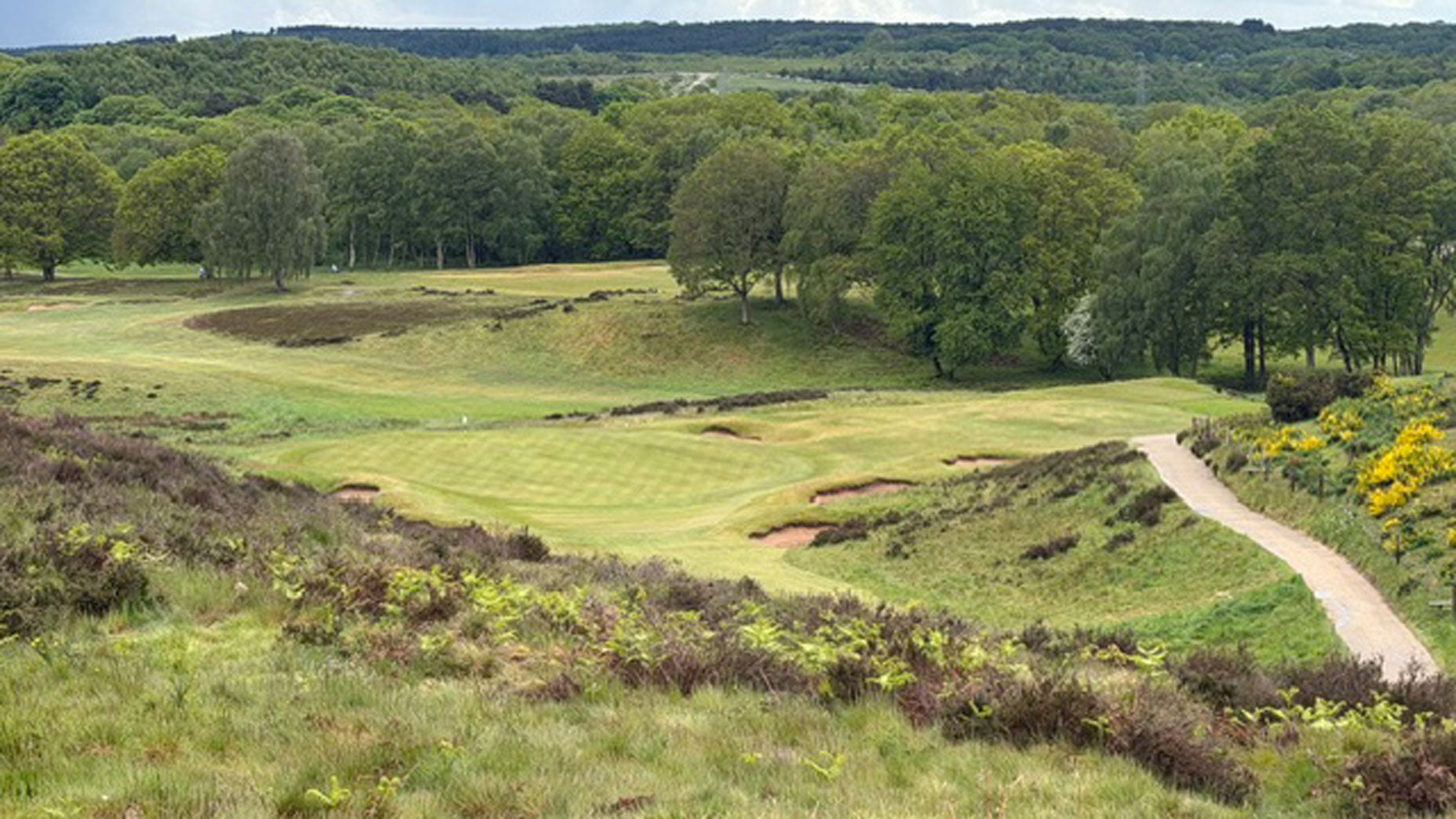
As we stood on the 2nd tee, I understood why Williamson thought the course should open on that side of the road. The hole provides the first — and perhaps most dramatic encounter — with a massive dune that comes into play many times on the other side of the road. Depending on placement of the tee shot, the second can be blind, or semi-blind to a green that sits at the base of the large dune that defines one side of the property. It’s a remarkable, natural hole, and a hallmark of a course that feels more discovered than built.
The par-4 4th, near the clubhouse, served as the first hole of Park’s original design, and it’s a stout test, playing longer than its yardage into a prevailing wind. That’s reflective of Nottinwell itself, which was routed in such a way that it has been able to withstand the test of time and the onslaught of technology.
The 7th is a great example of a wonderful hole on a flat part of the property with heather to carry off the tee and a series of beautiful fairway bunkers. Elsewhere, the land is more dramatic. Holes 10 through 17 take advantage of that terrain, interacting in various ways with the massive dune. The 11th, a short par-4, moves gently alongside it; the long par-3 13th, the best of a strong set of one-shotters, plays down off it; the 17th green and 18th tee nestle against it.
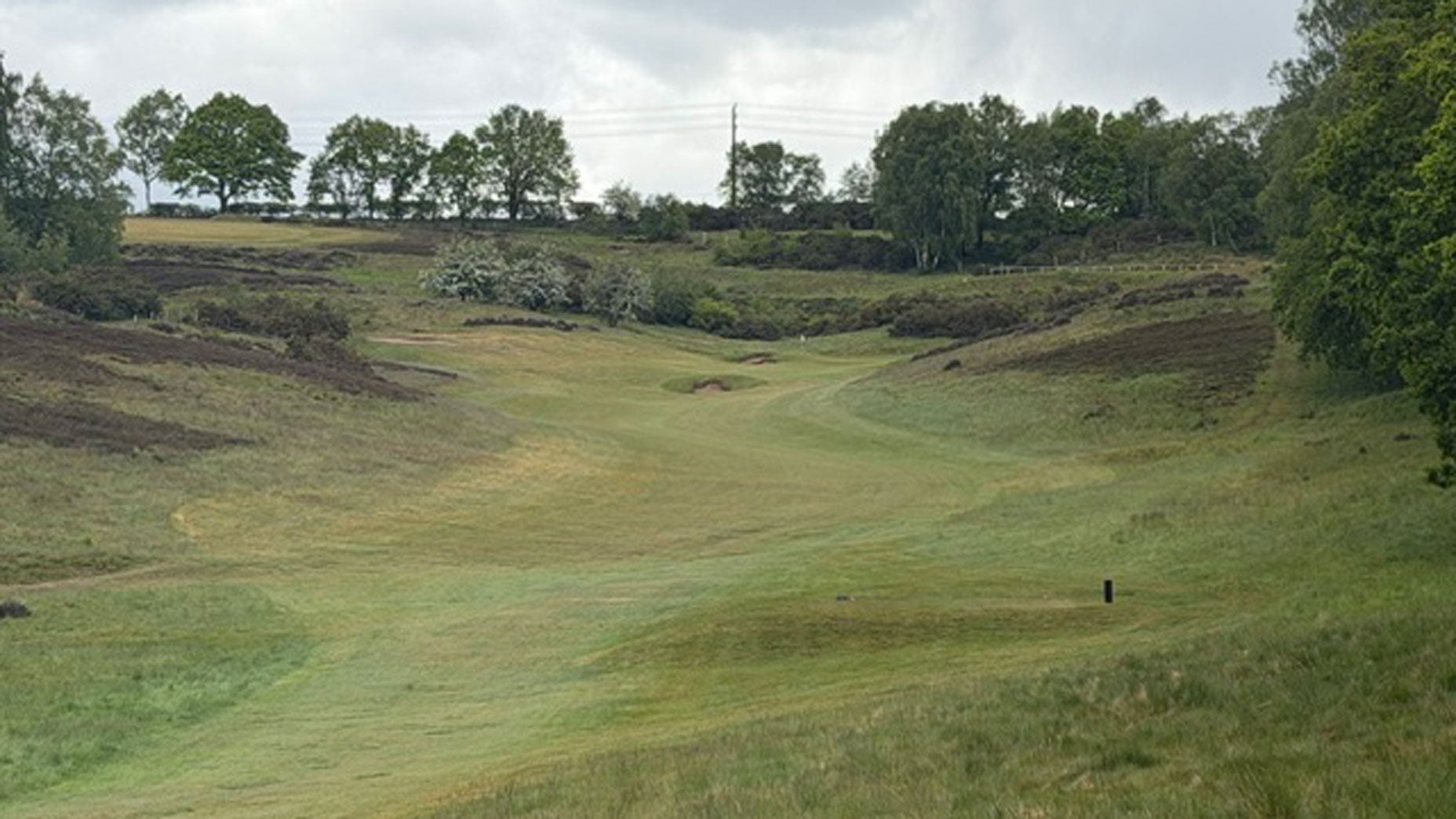
As we wrapped up our round, I couldn’t help comparing Nottinwell to our stops at Lofoten Links and Ardfin, two of the hardest-to-reach courses in Europe. When a course sits in a beautiful location, as Lofoten or Ardfin do, it raises a question: Should beauty count in one’s evaluation? I like to look at a golf hole and ask myself, if a hole on the edge of a cliff was instead on the edge of a forest would it still lodge itself in our memory.
I loved my time at Ardfin but I couldn’t help wondering: If it had the bounciness of a links, how much better might it have been? At Lofoten, I was awestruck by my surroundings, but the scenery was more of a spectacle than the course. At Hollinwell, the course itself was the star, and I marveled that its glitter hadn’t drawn more attention.
In an Instagram world, for better or worse, we will have fewer and fewer hidden gems going forward. We will not see a world where National, North Berwick and Chicago Golf Club are largely ignored the way they were 40 years ago.
But if you look hard enough, you can still find a place like Hollinwell. And thank goodness for that.
The post This unheralded course 2 hours from Royal Birkdale deserves way more shine appeared first on Golf.