WOODMONT, Md. — Tyler Cashman shares the news with a startling deadpan: He’s just fired his caddie.
“To come and do it at this level, you have to have someone that you can trust and depend on,” Cashman says, pausing for a beat before delivering the knockout blow. “…I’m still looking for that.”
Five feet away, Cashman’s caddie rolls his eyes.
“You fire me five times a round,” the looper says, a neon-green bib over his shoulders. “You’re going to have to do better than that.”
The unspoken truth is that Tyler’s caddie has enviable job security. Not only is George Cashman a vital role player at this week’s U.S. Adaptive Open here at Woodmont Country Club but he’s also Tyler’s grandfather.
“I mean, that yardage on 1 was terrible,” Tyler says, grinning.
“Let’s go back out there right now and check it with the laser,” George snaps back playfully. “And then we’ll both know that I’m right.”
Suddenly, it hits Tyler that he might want to drop the act, because Grandpa George might actually be right.
This is a possibility that Tyler, who is 23, has had to contend with more than he would like in his formative years as a knucklehead boy growing up in Tewksbury, N.J. Not just because he is unusually close with the members of his support system but also because those people are his lifeline. Their jobs are varied and almost always mundane: introducing people to Tyler, clearing obstacles in his path, helping him get from one place to another, sparing him from small embarrassments like trips and forgotten faces and, yes, caddying. And yet there is an unmistakeable tenderness in their mundanity, a kind of autonomous empathy and strident protection among Tyler’s inner-circle that can arrive only from a place of deep, unconditional love.
The world has not always been kind to Tyler. In elementary school, he saw more doctors and specialists than most will see in a lifetime, and most of them produced little more than a shrug. In middle school, he learned he would have to stop participating in his favorite activity — baseball — because it was too dangerous. In high school, the athletics department needed to be compelled to afford him the small dignities legally afforded to him by the USGA.
“You feel like a terrible mother,” says Casey Cashman, Tyler’s mother. “And then you think, I’m the lucky one. I can fight for him. What about all the parents who can’t?”
George Cashman does not say it, but his work as a caddie is about more than quality time with his grandson. It’s about protecting Tyler from that — about making sure that he never lives a day experiencing what it is like to be less than on account of his differences.
This is what makes Grandpa George’s job so essential: It’s hard enough to be a tournament golfer without a caddie.
But it’s damn-near impossible when you’re blind.
View this post on Instagram
BEFORE HE WAS A GOLFER, Tyler Cashman was a traveler.
Tyler’s grandparents, Cindy and George, had always planned to travel in retirement. But once doctors discovered Tyler suffered from a rare genetic condition that caused the slow degeneration of his eyesight, that plan shifted into overdrive. Now Cindy and George weren’t just enjoying their golden years, they were locked in a race against time.
“We wanted to fill up his memory bank,” says Tyler’s grandmother, Cindy, recounting the globetrotting trips with her grandson that filled many of his early years. “That’s what the doctor told us to do, before his vision went away.”
As it turned out, Tyler’s memory bank filled with more than just beautiful places. He forged a close bond with both of his grandparents, two old-fashioned heads of family who showed love through laughter … well, mostly.
“He really became like our fourth child,” Cindy says. “We weren’t afraid to set him straight, but mostly we just loved our time with him.”
On one of those early trips George first suggested golf to his grandson. Grandpa George was a diehard, playing five times a week in retirement after a long career at a railroad-equipment company, but more than that he was a realist. If Tyler’s vision was going to continue declining, which was what most doctors predicted, George figured his grandson ought to find an outlet that he could pursue even after he’d crossed the threshold into blindness.
George had read up about adaptive golf and knew that Tyler would be able to play no matter what happened to his vision, and under certain rules from the USGA, he would even be afforded certain rules courtesies that would allow him to compete against able-bodied players.
Tyler finally picked up the game in 8th grade, and quickly realized he had an aptitude for it. He started playing on his high school team, and later began competing in adaptive events. The experience of being on the course was enthralling, but the real joy came from what golf did for his sense of self.
“Tyler has developed an incredible sense of hearing, which is normal for blind people,” George says. “What’s interesting is that when they would play individual matches . . . he would be able to hear his competitors whisper, ‘Do you realize you got beat by a blind kid?’ That happened all the time. That was just so inspiring to him.”
Grandpa George caddied everywhere he could, obsessing over the tiniest details of his grandson’s game and beginning a (now longstanding) tradition of matching his attire with Tyler’s at every event.
It wasn’t long before the pair had formed an inseparable bond — as family, as friends and, later, as equals.
“When he first started, he had his own idea of how he wanted to play golf. I had a different idea,” George says, grinning again. “He’s more aggressive than I am, and back then I would overrule him – ‘No, no, this is what we’re gonna do.’ Now, as he’s grown, he’s the player, it’s his score, it’s not my score. So we defer to him.”
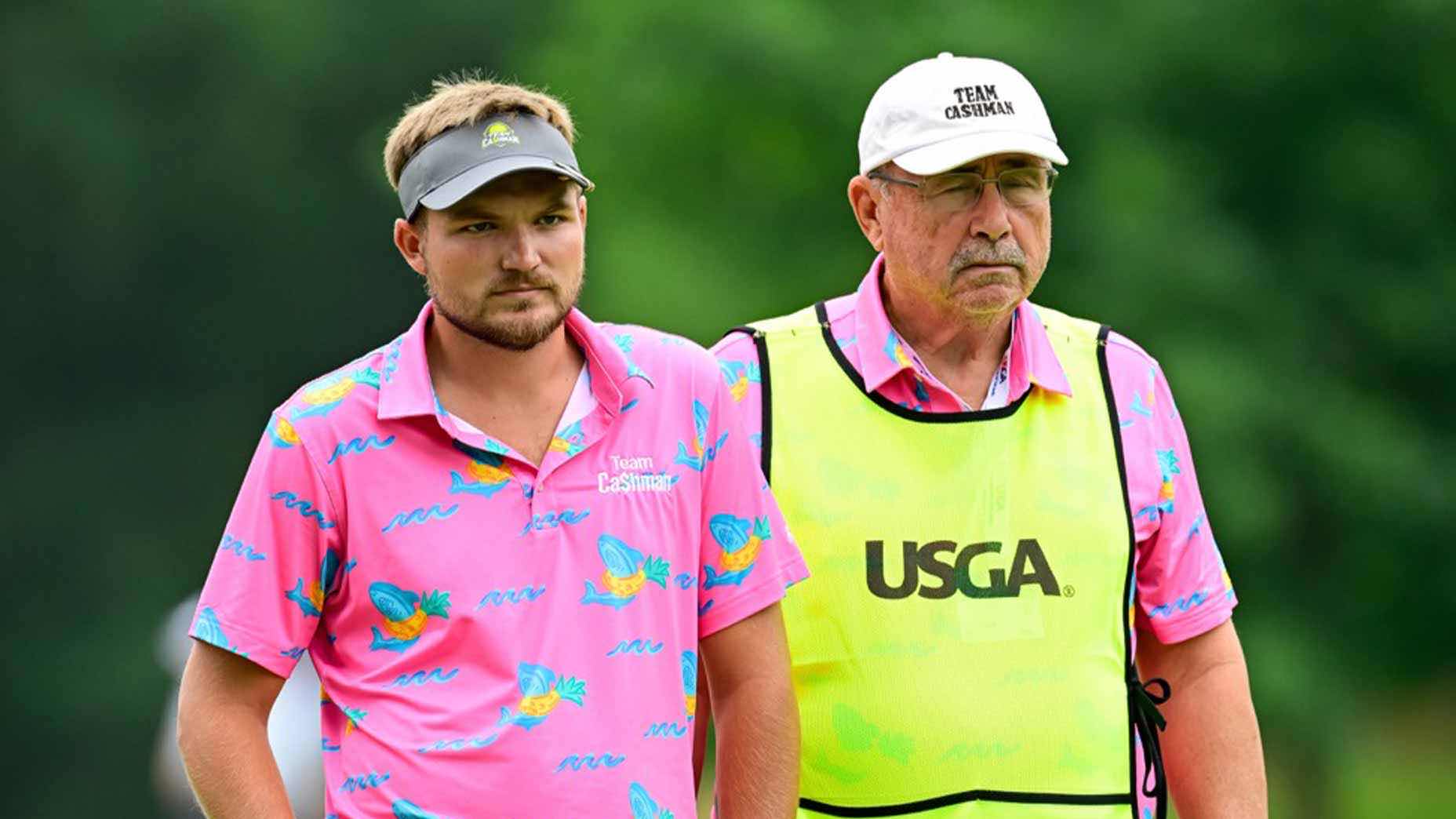
Tyler’s sight has stabilized. After a stem-cell treatment, his vision loss has held steady for more than two years at less than 5 percent in one eye and less than 20 percent in the other. On the course, that stability has manifested in a staggering degree of success for the player-caddie duo.
“We’ve been all over the world for golf,” George says. “We won the world championship in Canada last year — that makes Tyler the number one player in the whole visually impaired [golf] world.”
But it also makes Grandpa something, too. He plays a major role in Tyler’s success, fixing his grandson’s alignment, tracking his balls in the air and filling in the gaps that Tyler otherwise can’t see. He treats the work with all the seriousness of a veteran Tour caddie.
“He missed their first U.S. Adaptive Open start a few years ago because he needed a knee replacement, so one of our friends stepped in,” Cindy says. “Well, our friend checked his phone after the first round and he had pages of notes from George on what to improve.”
She laughs.
“He ignored the message, which was probably good for our friendship,” Cindy says. “And George never missed another caddying assignment again.”
This week, at the U.S. Adaptive Open, the duo is shooting for the biggest prize of their collective career. Medals are awarded to the low scorers in each impairment category in the event, which, in its fifth year, is the biggest in adaptive golf. A victory in the “visual impairment” category would not come with a winner’s check, but it might be enough for an even rarer achievement: quieting Tyler and Grandpa George’s banter for an evening.
On Monday at Woodmont, that accomplishment was still a ways away.
“The good shots are his, the bad shots are my fault,” George says.
“Yeah, pretty much what I can do in spite of you,” Tyler says.
“Exactly,” George says. “We make a good team.”
Grandpa George is kidding, as he usually is.
But there’s a part of him that isn’t — a part that comes out after Tyler turns his attention back to the scorer’s table.
“I enjoy caddying for him more than I do playing,” George says. “For most people, golf is a thing you do alone. For us, it really is a team sport.”
Grandpa George does not say it, but it’s clear there is a part of him that thinks there is some good that came of Tyler’s bad break. It brought the two of them together.
“We’re a team,” he says. “We don’t to play with anyone else.”
And yet, as the team prepares to head off into yet another evening together, the topic of job security percolates again.
“How many times do you think you’ll fire me tomorrow?” George asks.
Tyler’s reply comes quickly.
“I don’t know, probably every hole.”
The author welcomes your thoughts at james.colgan@golf.com.
The post He went blind. Then he found golf through an unexpected hero: Grandpa appeared first on Golf.