If you’ve ever felt a special kinship to, say, an old sycamore in your yard or a center-hall colonial that’s been in the neighborhood since Millard Fillmore was in office, that’s how Rob Wolf III feels about golf courses designed by Golden Age architect Walter Travis. Wolf is so drawn to Travis designs — of which there are about 50 in the U.S. — that he has made it part of his life’s work to help honor and preserve them.
Wolf’s love affair with Travis’s stylings began in his teenage years, when he caddied on the sandy Travis terrain at Hollywood Golf Club in Deal, N.J., and blossomed as he grew familiar with other Travis designs at such clubs as North Jersey; Troy, near Albany, N.Y.; and Scranton in northeastern Pennsylvania. More recently, Wolf formalized his affinity for Travis when he became president of the Walter J. Travis Society, a pack of 100 or so Travis fanatics dedicated to protecting, restoring and archiving the designer’s work.
“That is our focus,” Wolf, who is 58 and lives in New Hampshire, told me in a phone interview the other day. “Politics aside, opinions on architecture aside.”
Lately, though, ignoring politics hasn’t been easy as a historic and beloved Travis design has come under threat: the 18-hole Blue Course at East Potomac Golf Links in Washington, D.C. Until recently, the century-plus-old muni was destined for a Tom Doak restoration that would pay homage to the original design, a job assigned to Doak by the course’s former lease owners, D.C.-based non-profit National Links Trust. But late last year President Trump’s Interior Department terminated the lease, alleging mismanagement by NLT. (NLT has refuted those claims.)
Doak was out, too, replaced by a designer with a more modern sensibility, Tom Fazio, who is friendly with President Trump and has his name on four of the president’s courses. Fazio’s plans for the site call for much earth-moving and a rerouting of the existing layout; he intends for the course to be playable for beginners but, when stretched out, to have enough muscle to test even the world’s best golfers in big-time tournament settings. “The president’s idea is to upgrade it to be literally a national monument — and there’s no reason it can’t be a national monument,” Fazio told GOLF.com last month.
To Travis-o-philes and other preservationists with an interest in protecting D.C.’s institutions, Fazio’s plan is cause for grave concern. “Under the guise of a shiny new object,” Wolf said, “this runs in direct conflict to what most of the astute golfing world is doing when addressing their classic courses and trying to bring them back to what they once were.”
This runs in direct conflict to what most of the astute golfing world is doing when addressing their classic courses.
WHEN TRAVIS DESIGNED THE East Potomac course in 1917, he was handed an enviable plot, roughly 220 acres on a manmade peninsula in the Potomac River with views of the Washington Monument, Capitol Building and, to the west, Arlington, Va. The first nine holes opened in 1920 followed by the second nine in 1923. Travis, who took his cues from the classic courses of Great Britain, designed a reversible routing, not only as a nod to the Old Course at St. Andrews but also to help the turf better weather the armies of golfers that would descend upon it — and descend they did. By 1921, the first nine holes were doing up to 600 rounds a day.
The land was flat but not defenseless thanks to Travis’s strategic bunkering and artful greens. ”Rigidly trapped,” is how the great golf writer O.B. Keeler described the course in 1923, “and with the diabolically characteristic billowy ‘Travis greens’ seen at Garden City,” as in Garden City Golf Club, the Long Island enclave that houses one of Travis’s most highly regarded designs. Keeler continued, “The greens were beautiful to see and in fine condition; but the humps tended to complicate matters, especially on approach shots.”
The course today is not the same course Travis laid down. Gone are the reversibility and two-way greens, along with some hazards that were removed in the 1930s. In that same era, the back nine was re-routed to make way for a driving range. Trees that were not part of Travis’s original design also have encroached on the course. Still, most of the holes sit in the original corridors.
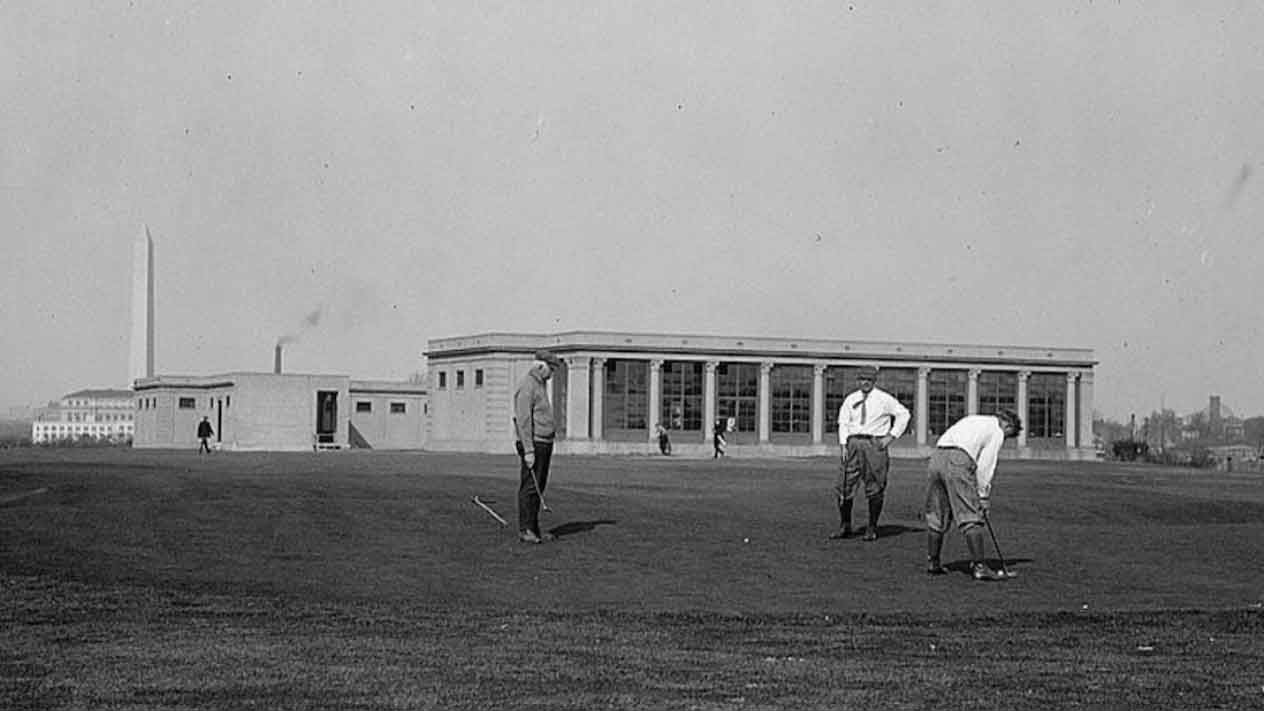
Fazio told GOLF.com that part of the reason he is straying from Travis’s original vision is because source material is limited. “Who knows what was original?” Fazio said. But Wolf said that, in fact, much of Travis’s plan not only exists but is available in the public record. That material, which GOLF.com reviewed, includes sketches of all 18 holes; detailed, annotated maps of the routing; and aerial black-and-white photography of the completed course. “The best playbook ever,” Wolf said. “That is not the opinion of just me as the president of the Travis Society but of all our membership and anyone who realizes how rare an opportunity this is.”
Fazio had not seen the reference material until GOLF.com shared it with him late last week. “I’m glad to see it,” he said in a phone interview Wednesday. “It’s good information. Golf is a game of tradition and history, and I think it’s logical to look at that.”
Fazio is not blind to what East Potomac’s roots mean to D.C.’s golf community and custodians of the game like Wolf. “I like the whole idea of the Travis thing,” he said. “So we’re keeping that in mind, and I think that’ll be a nice something to look at as [we assess] the history of the property.” But he also said restoring exactly what Travis laid down isn’t practical. “I think keeping some of that tradition is great,” he said. “But there’s a blend. There’s a lot of things we need to do to blend.”
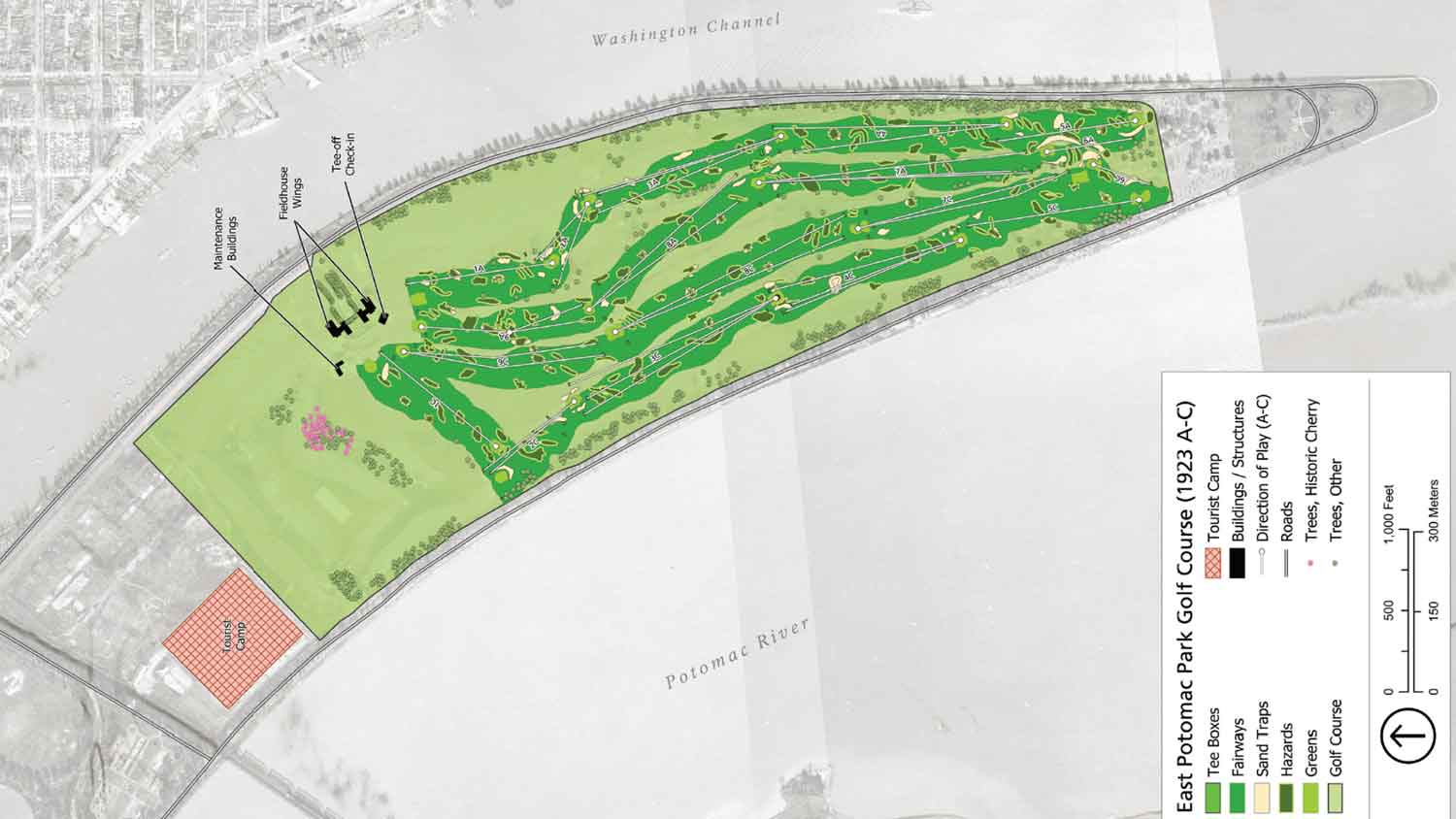
FAZIO SAID HIS TOP PRIORITY, at least in the near term, is solving for drainage on a piece of land where flooding and sogginess is a persistent issue. To combat water pooling on the course, Fazio will need to elevate much of the land. “The only way to have good quality turf grass is to have a high and dry playing surface,” he said. “You have to make the water flow off and move off in order to get quality turf. So that’s what we’re analyzing now. We’re going to have to dig some lakes in some areas to get filled dirt out of the ground and put that dirt in places to literally crown, elevate, move the land so we can push the drainage water to the detention basins or lakes and areas away from the greens.” That kind of work — essential work, as Fazio sees it — will by default change some of the character of the layout.
Fazio also has no intention of reviving Travis’s reversible routing because he says it’s not practical from a cost and operations standpoint. Ditto the volume of bunkers that were in Travis’s original design. Fazio said it would be too costly to build and maintain them all. He said the style of Travis’s signature steep-faced bunkering “is one thing that we could probably keep,” but that, too, would come with maintenance challenges that are “probably not the best thing for municipal golf.” More bunkering would also slow down play, Fazio said.
A complete restoration of East Potomac wouldn’t just require more bunkers but also removing many of the trees that have grown on the property since Travis’s design came to life. Among them are cherry trees that light up the course when they blossom in the spring. Fazio has no plans to fell them, in part because President Trump is fond of them. “The president has mentioned that several times he loves the trees,” Fazio said. “He wants to make sure we protect those trees and take care of the trees.”
Finally, Fazio said, there’s the broader matter of keeping up with the times, as in building a course that will sufficiently challenge the modern player. “It sounds good, preserving the past; we like to do that,” he said. “But can you imagine Donald Ross coming alive and standing near the first tee at Pinehurst or Walter Travis coming out to one of his golf courses and seeing today’s players hit a golf ball with today’s equipment? Today’s game is totally different.”
There are, of course, dozens of recent restorations that challenge even the longest hitters: Gil Hanse’s work at Baltusrol Lower and Upper; Andrew Green’s redo of Oak Hill; Geoff Ogilvy and team’s sharpening of Medinah No. 3, and on and on. As for exemplary Travis restorations, Wolf points to work at Hollywood, Garden City, North Jersey and Ekwanok in Vermont. Getting those kinds of projects right, Wolf allows, isn’t easy. The work can be painstaking but is worth the investment of time and resource.
“It is much harder to restore a course than it is to start fresh with a bulldozer and new plans that are computer generated,” Wolf said. “The best architects in the world will tell you that — be it Coore & Crenshaw, be it Doak — hence when they go into a restoration project, it’s a lot more difficult to do the archival work and figure out what was there and how to bring it back than to start fresh.”
But at East Potomac, Wolf said, Fazio has what he needs: a clear road map that can and should be followed. The site is significant not only to Travis preservationists but also to the history of the game at large, Wolf said, for its spectacular setting, in the heart of the nation’s capital; its unconventional reversible-routing; and its accessibility: Anyone can play it for less than $50. Wolf agrees with Fazio that vegetation and general neglect have changed the personality of the course, but that evolution, or devolution, he said, can be reversed.
“To restore something as high profile in that location, to get it right with the massive amount of data available, would be an amazing accomplishment,” Wolf said.
***
THE TRAVIS SOCIETY ISN’T the only organization interested in preserving East Potomac. In May, the DC Preservation League filed an emergency motion to stop the administration from “irreparably destroying” the park and its golf course. The filing alleges that the defendants have “adopted to transform East Potomac Park in a way that will irrevocably and significantly harm the quality of the human environment, affect historic property, violate NPS’s [National Park Service] conservation mandate, and thwart East Potomac Park’s purpose as ‘a park for the recreation and pleasure of the people.'”
The next hearing for that motion is scheduled for July 2, and thus far, said Rebecca Miller, the DC Preservation League’s executive director, the National Parks Service has not submitted filings to the required preservation and planning commissions. “Those are all things that need to happen in order for people to react to whatever it is that Fazio has designed at this point, and we’re not able to do that until we have that information,” Miller said.
Miller is hopeful the judge will issue an injunction that would prevent the NPS from proceeding with any construction until it has buy-in and sign-off via the appropriate channels. Whenever the project does get underway, Miller, like Wolf, would like to see a faithful restoration of Travis’s design. “Under Section 106 of the Preservation Act, that golf course is character-defining for the historic district,” Miller said. “So, yes, it should be restored. If there are going to be changes made, those changes can be minimized so that they have less of an adverse effect on the course.” She added, “A wholesale redesign would not be consistent with preservation standards.”
Wolf said that the Travis Society has been approached about joining suits challenging the administration’s plans for East Potomac but has declined to sign on as a plaintiff. “We will, where possible, if it meets our criteria of mission, sign on to amicus briefs, but that’s it,” he said. “We’re not getting into the political vortex of this.”
However the legal proceedings play out, Wolf is hopeful that this pause in the process will give Fazio and his team time to reconsider their plans, because “as we’ve seen with prior articles and discussion, the favor of replacing [the course] is not in line with the opinion of the golfing public who knows what is there and who wants to see affordable public access to great classic architecture.”
Fazio, meanwhile, said he and his team are eager to get started as soon as possible. He knows there are differing opinions about what form his work should take but said it’s impossible to please everybody.
“Like a lot of things in golf,” he said, “there is no absolute answer.”
The post Trump wants a new-look golf course in D.C. Preservationists have another idea appeared first on Golf.