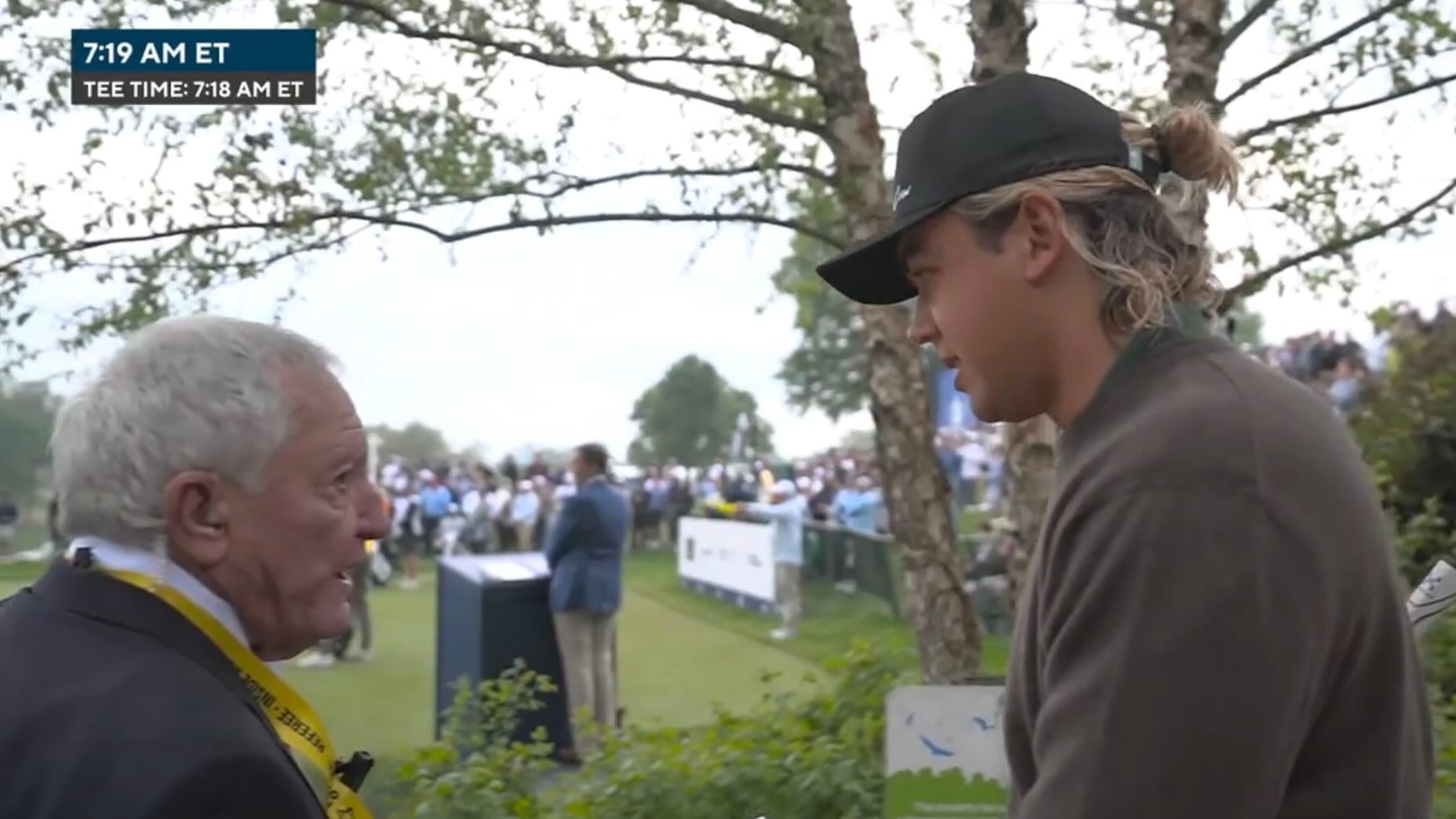
NEWTOWN SQUARE, Pa. — Garrick Higgo, a 27-year-old golfer from South Africa, is about as chill as a golfer could be. But early Thursday morning, in the chilly air out here in affluent suburban Philadelphia, a feeling of sickness came over him. Higgo was on the Aronimink Golf Club’s practice putting green, hard by the clubhouse and about 15 feet above the course’s elevated first tee, when the starter said these words:
“From Memphis, Tenn., the 2003 PGA Championship winner, Shaun Micheel.”
The first player in Higgo’s threesome had been summoned to the tee, and Higgo’s two-shot penalty already was in motion. Rule 5.3a.
Everything else is commentary.
From down below, Higgo could hear his American caddie yelling urgently, “C’mon, c’mon, c’mon.”
It didn’t matter.
Garrick Higgo was late to the tee. Not fashionably late. Two-shot late. He ambled down the hill, sweater on his large frame, broomstick putter in hand.
He’s a large man, listed as a six-footer, probably about 200 pounds, with oak-tree legs and a thick waist. Higgo knew, as pros always do, who his Thursday-Friday playing partners would be. In this case, Shaun Micheel, now 57, and Michael Brennan, a former Wake Forest golfer who won on Tour last year. They were in the fourth threesome of the day off the first tee, and their tee time was 7:18 a.m. When Higgo arrived, it was 7:19.
Before that, the day had been unexceptional, if you could call any day in which you are playing in a major championship unexceptional. This is Higgo’s eighth major.
He arrived at the course long before sunrise, which was at 5:46 Thursday morning. His caddie, Austin Gaugert, was already there. Higgo saw his physiotherapist. He went to the gym. The morning was cold, still and damp. He walked to the range, on the east side of Aronimink’s massive, English-style clubhouse. He went to the short-game practice area, on the north side of the clubhouse.
Gaugert, a tall and lanky Wisconsinite, gave Higgo his putter, put a practice club in Higgo’s locker in the clubhouse and headed to the first tee. Higgo went to the small practice putting green on the south side of the clubhouse; he was putting and hanging and not worried about anything but keeping warm when Micheel’s name was called. Maybe he didn’t hear that, but he did hear his caddie calling for him. There were caddies and players and coaches all over the green. The 7:30 tee time, the 7:42 tee time. Tournament golf is a parade and a march. Somebody got out a phone. It was 7:19. Higgo was told of his two-shot penalty as soon as he arrived on the tee.
Higgo turned pro in 2019. He’s played and won all over the world. He knows the drill. Under normal circumstances, at the majors and on the PGA Tour, a group’s first player is called to the tee at the group’s precise tee time. The players are required to be on the tee, club in hand, at that time. The penalty for not being there — on the tee, club and ball in hand — is two shots.
It doesn’t matter if your lateness does not result in a delay of play.
It doesn’t matter whether, in the order of play, you’re first or second or third.
It doesn’t matter if there are extenuating circumstances. In other words, there are no extenuating circumstances.
‘That’s 2 shots’: Pro shows up late, penalized at PGA Championship
You can read the exact language in the USGA rulebook. It’s all spelled out. If you are more than five minutes late, you’re disqualified. A PGA official told Higgo he was getting a two-shot penalty before Higgo hit his first shot on a 430-yard par-4. He drove it right down the middle, pitched to the back of the green and took two putts for a score that looked like a 4 but was a 6 on the card. He was two over through 1. He was one under through 18. Thirty-five out, 34 in for a solid 69.
Revisiting the early-morning events with reporters after his round, Higgo’s mindset was not a picture of clarity. Higgo did not seem to realize that Micheel already had been called to the tee. He described meeting with PGA of America rules officials when he came in.
“I was just trying to get evidence — I feel like any of you would have done the same,” he said. “I was there on time, but the rule is, if you’re one second late, you’re late. So if you think about it, I was there on time, if you know what I mean.”
Not entirely.
He was handed his scorecard and told of his penalty. His caddie handed him his driver. “I just kind of focused on what I need to do,” Higgo said. “I mean, I wasn’t going to give up and shoot 80.”
Higgo thinks of Ernie Els as an uncle and Gary Player as a grandfather. In 2018, during UNLV’s spring break, Higgo stayed with Els in South Florida and told him he was not comfortable with the party scene at UNLV. He is a devout Christian and, though he looks like a surfer dude in the Jeff Spicoli tradition, he is nothing like that. Els told Higgo he was mature enough, and his game was mature enough, to turn pro. Higgo turned pro the next year. He won the Portuguese Open the next year.
On Thursday, Els had some new advice for his protégé.
“The kid must be on the tee five minutes before his tee time,” Els said by text. “End of story. You can argue until you’re blue in the face. But even every junior golfer knows that.”
It didn’t take long before Higgo’s two-shot penalty was a discussion topic among players and caddies. Some wondered if a two-shot penalty was too extreme, that one shot might be enough of a deterrent.
“I don’t know what the penalty should be, but you have to have something,” Brooks Koepka said.
“Two is kind of severe, but it happens so infrequently, maybe two is the right number,” Ludvig Aberg said.
In his long career, Jack Nicklaus never was late to a tee time. He never failed to count his clubs on the first tee. He never signed an incorrect scorecard. The starting point for tournament golf is a measure of discipline, and abiding by the game’s rules.
“It’s a rule,” Higgo said in a burst of clarity. “And I broke the rule.”
The post Inside Garrick Higgo’s bizarre (and costly) PGA Championship start appeared first on Golf.